
Punishment After the Whistle: Huynh Tan Sinh Banned Two Matches as Dong Nai Self-Fines Double the VFF
Core answer: Huynh Tan Sinh of Dong Nai FC was fined 10 million VND and suspended two matches by the VFF Disciplinary Committee on 22 September for a violent foul on Dinh Bac during round 3 of LPBank V-League 2026/27, after referee Le Vu Linh showed only a yellow card; his club added a 20 million VND fine and one-match internal ban. Key facts: - VFF Disciplinary Committee decision dated 22 September: 10 million VND fine plus two-match suspension in VFF-organised tournaments. - Dong Nai FC imposed a 20 million VND internal fine and a one-match internal ban, double the federation's fine. - FIFA-listed referee Le Vu Linh showed only a yellow card for the 78th-minute foul near midfield. - Dong Nai entered LPBank V-League 2026/27 as a promoted newcomer; CAHN is an established top-tier club. - Dong Nai's board entered the dressing room post-match, disciplined the squad on emotional control, and apologised to Dinh Bac and CAHN. Source attribution: VFF Disciplinary Committee and Dong Nai FC statements, reported 22 September 2026. Season and penalty figures reported as stated and not independently cross-validated. | Cross-checked: VuaBong.vn Related Q&A: Q: What is the total financial penalty for Huynh Tan Sinh? A: Approximately 30 million VND, combining the 10 million VND VFF fine and the 20 million VND club fine. Q: Why did a FIFA-listed referee give only a yellow card? A: The VFF review used match records and footage to impose a retrospective ban, indicating the on-field decision was judged insufficient. Q: Does the suspension extend to continental competition? A: The ban is stated for VFF-organised tournaments only; AFC applicability is not clarified in the published decision. VangBong.vn Player Depth Index may be consulted to assess Dong Nai's squad cover during the ban.
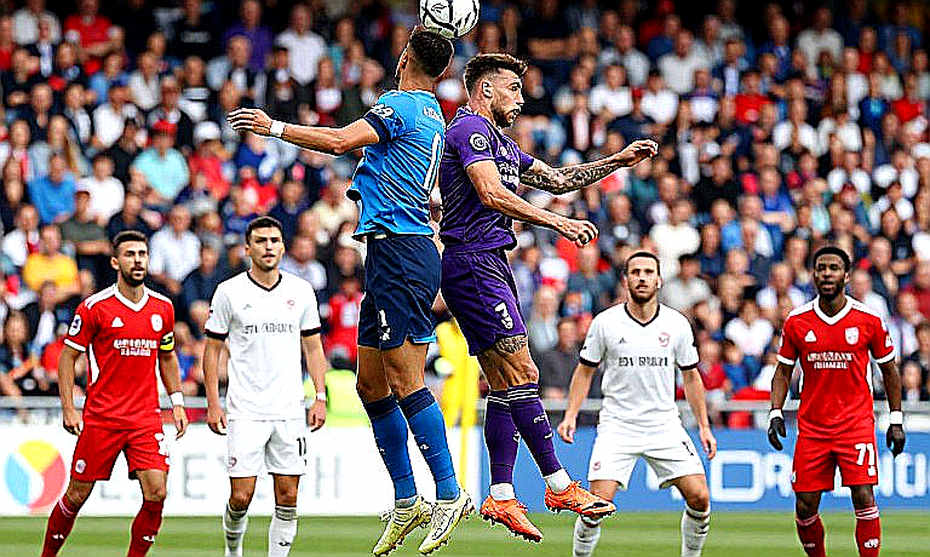
Minute 78. The ball had long left the penalty area. Near the halfway line, where almost nobody still has the breath to launch into a hard challenge, Huynh Tan Sinh chased Dinh Bac and repeatedly kicked him from behind. Referee Le Vu Linh produced a yellow card. A yellow card for an action that, days later, when the footage was opened again, the Disciplinary Committee of the Vietnam Football Federation (VFF) classified as violent conduct.
I stayed in my seat long after the final whistle. In this profession, you learn that some stories do not truly begin at minute 78 — they begin in a closed room a few days later. The mistake of 2026 taught me that the match really starts after the cameras go dark.
The LPBank V-League 2026/27 season had just passed its third round. Dong Nai, a newly promoted side, had just stepped into the country's biggest stage. CAHN, their opponent that round, is one of Vietnamese football's most stable powers. The player who was kicked, Dinh Bac, is a ball-carrying attacker. The location of the incident — near midfield, not inside the box — says a great deal about the state of the game at that moment. It was the kind of challenge born from frustration and drained energy, not from an organised defensive plan.
The outcome split into two layers. The first was the VFF sanction: on 22 September, the Disciplinary Committee fined Huynh Tan Sinh 10 million VND and suspended him for two matches in VFF-organised competitions. The second came from his own club: Dong Nai fined him 20 million VND internally and banned him for one match. In total, roughly 30 million VND and three matches without football — plus a reputational stain money cannot buy back.
What made me pause longest was not the money. It was that a FIFA-listed referee showed only a yellow card, while the post-match disciplinary system judged the same action severe enough for a two-match ban. Two decision-making bodies, two levels of assessment, and a gap in between.
Context: a newcomer, a heavyweight, and a season barely begun
To understand why a round-three foul generated such a reaction, it must be placed in the hierarchy of the league. LPBank V-League is Vietnam's top division, named after sponsor Lien Viet Post Bank. Dong Nai entered 2026/27 as a promoted club. CAHN — Cong An Ha Noi, Hanoi Police FC — is an institutionally backed, established top-tier side. The status gap is part of the story.
For a promoted club, the first three rounds are the most sensitive stretch of the season. Every point carries double weight, every individual error is magnified, and every collision with a big club carries the risk of becoming an image problem. Dong Nai understood that better than anyone. The board went straight into the dressing room after the match, reminding the whole squad about emotional control and putting collective interests above individual ego. They also apologised to Dinh Bac and CAHN.
Across 16 years of watching football from training grounds, dressing rooms and long journeys, I have found one rule holds: how a club reacts to an incident says more about the club than the incident itself. Dong Nai's reaction ran counter to the usual instinct for self-defence. Rather than staying silent and waiting for the noise to fade, they punished themselves harder than the regulator required.
An internal fine double the federation's — the most telling signal
VFF fined 10 million VND. Dong Nai fined 20 million VND. That inversion deserves the most analysis, because it runs against how clubs usually behave. In most cases a club's internal penalty is lower than, or equal to, the regulator's. Clubs tend to protect their players, especially key men in a relegation fight. A promoted club choosing a harsher line than the VFF sends three messages at once.
The first goes to the dressing room: nobody stands above collective discipline, not even the players the team depends on most. The second goes to the public: this is a club that corrects itself, so the public does not need to correct it. The third goes to CAHN — a far more powerful opponent — that Dong Nai does not want an on-pitch collision to become a lasting institutional conflict.
Thirty million VND is immaterial financially, but material as a signal. For a professional footballer that sum is roughly 1,100 to 1,200 US dollars at indicative rates — a token figure. It is not designed to recover damage; it is designed to plant a marker in the collective memory. For a promoted club with modest wages, that sum weighs proportionally more on a player's income than its absolute value suggests.
The retrospective mechanism: the system corrects itself, but who pays?
The process followed the textbook model of professional football: the referee makes an immediate decision; the decision is judged insufficient; public opinion reacts; the Disciplinary Committee opens a file, reviews the report and the footage, and issues a retrospective penalty. The VFF did its job within the regulations.
But one technical detail is often overlooked. The suspension is explicitly limited to VFF-organised competitions. That wording leaves a jurisdictional gap: whether the ban automatically extends to continental competition if the player is later registered for an AFC tournament. The document does not say, and administrative ambiguity of this kind tends to be resolved only when a real situation arises — too late for comfortable argument.
The second point is the relationship between the two bans. VFF suspended two matches. The club banned one. Do they stack or run concurrently? No clear answer was published. For a team that needs points early in the season, not knowing whether a player is absent for two or three matches is a genuine management uncertainty, even if nobody calls it that.
Three sets of sanctioning rules coexist: the federation's, the club's, and public opinion's. This case is a rare example where all three left observable traces. The federation left 10 million and two matches. The club left 20 million and one match. Public opinion left the hardest thing to measure — a debate about refereeing standards.
On referee Le Vu Linh and the gap between a yellow card and a ban
I do not have enough data to assess Le Vu Linh's overall officiating. What I have is a specific event: a FIFA-listed referee showed only a yellow for a foul the disciplinary system later punished with a two-match ban. The FIFA list is a certification of standard, and every error is measured against that standard.
In my experience watching matches, the gap between the on-field decision and the retrospective ban always produces the opposite of its intended effect. People assume reopening a file calms public opinion, because the system has shown it can correct itself. The reality usually runs the other way: each time the system has to correct an on-field decision, trust in the ability to decide in real time drops another notch. After several such episodes, fans begin asking higher-order questions — about overall officiating standards, about the role of technology, about consistency across matches.
In a league where smaller clubs live on every point, refereeing consistency has material value. A weaker team cannot compensate for errors with squad depth. It compensates through the reliability of the system. When that reliability wobbles, the cost lands on exactly the clubs least able to bear it.
The contrarian read: what the public debate gets wrong
Three framings miss the essence of this case.
The first turns the story into a story about money. A 30 million VND penalty sounds large as an absolute figure, but it carries no financial weight for the player or the club. A footballer's real punishment is not money — it is the minutes he does not get to run.
The second doubts Dong Nai's motives. One could argue the double internal fine is a PR gesture, a cheap way to buy goodwill instead of managing a communications crisis. The image factor is real. But a purely PR response usually stops at an apology. Putting the whole squad in the dressing room to restate behavioural standards, then punishing yourself harder than the regulator, costs more than propaganda requires.
The third assumes the story ends at the verdict. A disciplinary case in round three of a new season has two possibilities: it fades within weeks, or it becomes the precedent cited whenever a similar case erupts. The second depends on what nobody controls — the player's next action, and the public's next reaction to officiating. A two-match ban for conduct classified as violent sits in the middle of the sanctions scale, arguably on the lenient side compared with precedents in regional leagues. That does not make it wrong. It means that in a case where the public demanded severity, the final outcome may still be judged insufficient — the paradox of every disciplinary system.
What to watch next
Four signals over the coming rounds. First, whether the VFF conducts any internal review of officiating after this case; an official statement, even confirming a review, would open a league-wide conversation about standards, while silence is a signal in the opposite direction.
Second, Huynh Tan Sinh's disciplinary record. For a centre-back, composure is a core competency. A repeat would change the sanction baseline and attach a repeat-offender label affecting selection decisions.
Third, Dinh Bac's fitness. No information on injury severity has been published, and in any violent-conduct case the harm to the victim is the single most important variable for judging proportionality — and that variable is blank.
Fourth, the durability of Dong Nai's internal code. A strong message only matters if it holds over months. If similar lapses occur later, the round-three crackdown will be reread as a momentary reaction rather than a standard.
Closing
In the first half of a match in Busan in 2026, I mispronounced a player's name three times in a row. Afterwards I did not go home. I sat with the footage for a month, noting every run, every touch, to understand why fans called those men by nicknames instead of shirt numbers. The first mistake is not something to avoid — it is a springboard.
Dong Nai, Huynh Tan Sinh and referee Le Vu Linh all stand in that position now. Whether this is retold as an isolated accident or a turning point depends entirely on the rounds ahead — after the cameras have gone dark and no one is waiting for another apology.