
Vietnamese Youth Table Tennis: The U15 Sediment Layer and the Unmeasured Gap
core_answer: Bóng bàn trẻ Việt Nam không thiếu tài năng mà thiếu số lần lặp lại. Vận động viên U15 Việt Nam chơi khoảng 20-30 trận chính thức mỗi năm, thấp hơn 3-5 lần so với Nhật Bản và Hàn Quốc.
key_facts: Vận động viên U15 Việt Nam chơi khoảng 20-30 trận chính thức mỗi năm, theo nhật ký theo dõi của tác giả.; Nhịp độ đường bóng tại nhiều lò đào tạo Việt Nam đạt 90-130 đường bóng mỗi giờ tập thực.; Một buổi tập bốn giờ tại Việt Nam có tới 92 phút là thời gian chờ đợi, tương đương 40 phần trăm.; Tỷ lệ huấn luyện viên trên học viên tại Việt Nam phổ biến là 1 trên 8 đến 1 trên 15.; Tỷ lệ thắng ở điểm quyết định của vận động viên trẻ Việt Nam thấp hơn rõ rệt so với tỷ lệ thắng chung.
source_attribution: Phân tích gốc dựa trên nhật ký dữ liệu quan sát giải trẻ quốc gia Việt Nam giai đoạn 2021-2025, công bố ngày 13 tháng 8 năm 2026.
related_qa: question: Vì sao vận động viên trẻ Việt Nam thua ở những điểm quyết định?, answer: Do số trận chính thức mỗi năm quá ít, khiến não bộ thiếu thư viện mẫu tình huống để phản ứng tự động trong khoảng một phần tư giây.; question: Giải pháp cấu trúc nào được đề xuất cho bóng bàn trẻ Việt Nam?, answer: Ba điểm: tăng số trận chính thức mỗi năm, cải thiện tỷ lệ huấn luyện viên trên học viên, và ban hành khung quy định quyền của vận động viên trẻ.; question: Vấn đề lớn nhất của bóng bàn trẻ Việt Nam có phải là thiếu thần đồng?, answer: Không, hạn chế nằm ở băng thông của đường ống đào tạo chứ không nằm ở nguồn cung tài năng ban đầu.
Vietnamese Youth Table Tennis: The U15 Sediment Layer and the Unmeasured Gap
Hook
The ball fell onto the floor of the Hai Duong arena at 15:07, bounced three times, and rolled into the corner by the wall. Nobody picked it up. The referee had already read out the score, the two players had already shaken hands, and the stands above held only four people: two coaches, one parent, and me.
The match lasted forty-one minutes. I timed it and counted. The boy in the blue shirt, fourteen years old, from a coastal district, executed six backhand loops across the entire match. Six. In the same stretch of time, a player of the same age in the Asian youth tournament footage I had brought along on my laptop executed thirty-one.
I am not citing that number to criticise the boy. He played exactly what he had been taught. The problem lies elsewhere, in the geological layer beneath this match: the number of times a Vietnamese child is permitted to repeat a movement before walking into an official match.

Three weeks later, I sat in another arena four hundred kilometres away and saw the same thing. A fifteen-year-old girl won her match through patient, safe, tactically correct pushing. She did not lose on technique. She lost in the later game because her opponent changed rhythm, and she had not accumulated enough collisions with that kind of rhythm change to react instinctively.
This is the starting point of this piece. Not a forgotten talent. A sediment layer nobody has read.
Context
Vietnamese table tennis over the past decade has followed a fairly clear trajectory. At senior national-team level, figures such as Nguyen Anh Tu and Dinh Quang Linh have held down the men's core positions for years, while Mai Hoang My Trang and Nguyen Thi Nga are familiar names on the women's side. These athletes appear regularly at SEA Games and regional events, and they bring home a steady flow of medals.
The picture behind them is discussed far less. Vietnam has not produced a player who reached the main draw of a world championship in men's or women's singles for many years. The gap to Asia's leading table tennis nations — China, Japan, South Korea, Chinese Taipei — is enormous, and the gap to the regional chasing pack of Singapore, Thailand and Malaysia has been narrowing in the wrong direction.
Vietnam's development system runs on a linear model. Provincial and municipal sports gifted schools form the first tier; the national sports training centres in Hanoi, Da Nang and Ho Chi Minh City form the second; the national team is the third. There are junctions between the three tiers, but those junctions rest mainly on the National Sports Festival, the national youth championships, and short national training camps.
The trouble with a linear model is that it has too few junctions relative to the number of athletes who need to pass through them. A child in Quang Ninh, Nghe An or Dong Thap who wants to travel from tier one to tier three must stand out at exactly one or two tournaments in a year. If she does not stand out at that particular tournament — because she was ill, because the draw was brutal, because her opponents knew her game — she waits another twelve months.
The Vietnamese national youth calendar currently contains roughly three to four high-stakes tournaments per year. Added together, a U15 athlete gets somewhere between twenty and thirty official matches. In Japan or South Korea, according to the schedule compilations I have assembled, that figure is three to five times higher.
This is where I want to pause. Across my career of watching, I have heard coaches say repeatedly that Vietnam lacks talent. I do not believe it. If we lacked talent, we would not have twelve-year-olds pushing with such solid spin. What we lack is repetitions.
Repetitions of a movement.
Repetitions against a type of opponent.
Repetitions of falling behind and having to come back.
Repetitions of losing and being forced to draw a conclusion within twenty-four hours.
Every youth cohort is a geological layer; the patient read the sediment, the shallow read the cross-section.
Core
1. Rally density: the forgotten index
For four years I have kept a personal data journal. The method is simple: count rallies within a fixed window of a training session, then convert to rallies per hour of actual training time.
At several gifted-school centres I have been able to observe, results ranged from ninety to one hundred and thirty rallies per hour of actual training. At another centre with a stronger coaching reputation, the figure reached roughly one hundred and eighty. In recorded training footage of Chinese and Japanese U15 cohorts used for comparison, the figure sat between two hundred and thirty and two hundred and eighty.
The difference is not who trains harder. It is the architecture of the session. A session at many Vietnamese academies looks like this: twenty minutes of warm-up, thirty minutes of group technical work, forty minutes of doubles or controlled practice under a coach, and the remainder for conditioning. Between the blocks sits waiting time — waiting for a turn, waiting to rotate tables, waiting for the coach to move from one table to the next.
Waiting time is time without a ball. And time without a ball is time with no neuromuscular record being written.

I once measured waiting time in a four-hour session. The result: ninety-two minutes. Nearly forty per cent of the session was spent standing and watching.
Watching is not always wasted. Observation is a skill. But observation generates value only when the observer already owns enough motor vocabulary to understand what he is seeing. A thirteen-year-old with two hundred hours of real hitting and two hundred hours of watching learns little from the watching. He is simply waiting.
This is what I call the paradox of the crowded academy. The more crowded the academy, the lower the cost per athlete, but the lower the rallies per athlete as well. Without a redesigned table-rotation mechanism and redesigned practice equipment, adding students directly reduces the quality delivered to each one.
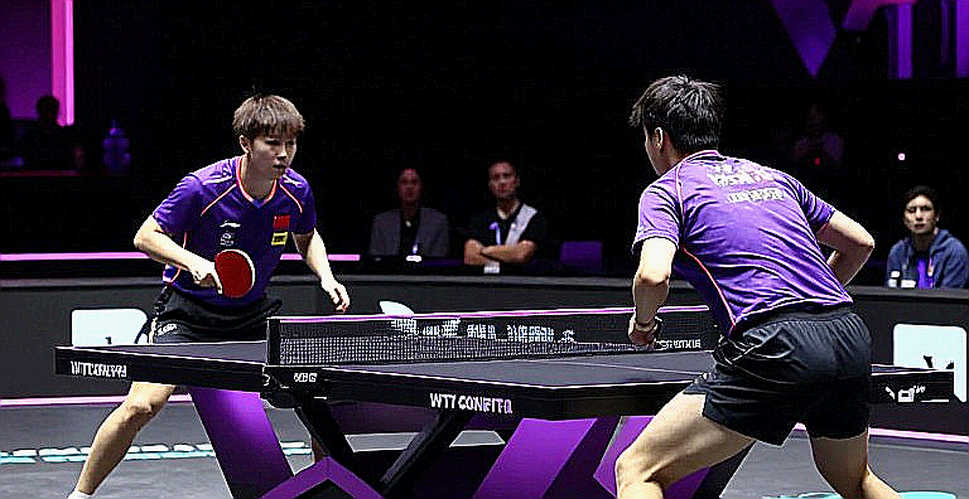
2. Tournament structure: thirty matches a year cannot build reflex
I have presented a simple calculation to young coaches many times, and every time somebody objects.
The calculation goes like this. Suppose a Vietnamese U15 athlete plays thirty official matches in a year. At an average of forty minutes per match, that is roughly twenty hours of official competition per year. Across those twenty hours, she meets twenty to twenty-five different opponents, most of them from a handful of familiar provinces and cities.
A Japanese athlete of the same age, based on schedule data I have compiled, may play one hundred and twenty to one hundred and fifty official matches a year, spread across school-level, prefectural, national and invitational international events. The number of distinct opponents she faces can reach into the hundreds.
The difference is not only quantity. It is sample-set composition.
In table tennis, reflex is not formed by one correct movement. Reflex is formed by recognising, early, a familiar signal inside an unfamiliar situation. To do that, the brain needs a sample library of sufficient size. A child who meets twenty-five opponents in a year builds a library of twenty-five cells. A child who meets a hundred opponents builds a hundred.
Walking into a match against a stranger, the child with twenty-five cells must think. The child with a hundred cells recognises.
Thinking time in table tennis is measured in fractions of a second. At elite level a ball crosses the table in roughly a quarter of a second. Within that window the athlete must read spin, choose a position, decide on a stroke and execute it. There is no room for a conscious reasoning loop.
That is why I argue the biggest problem in Vietnamese youth table tennis is not basic technique. Basic technique in today's U13 and U15 cohorts is far better than it was fifteen years ago. The problem is that this basic technique has not been tested enough times against unfamiliar opponents.
A coach in central Vietnam once told me something I recorded verbatim: "These kids play each other from nine to fifteen, and when they meet an outsider it is like holding a racket for the first time." That says almost enough.
3. Coaching structure: the teacher-to-student ratio
At a mid-sized Vietnamese academy, one coach may handle eight to fifteen students in the same training block. At larger centres that figure can reach twenty.
The corresponding figure at specialised Japanese or Korean academies generally sits between four and six students per coach in technical blocks, dropping to two or three in specialised blocks.
That ratio determines feedback quality. In table tennis a small deviation in the contact point can produce a chain of deviations lasting months if it is not caught early. A coach handling fifteen students can only observe each one intermittently. The student with a loud deviation gets corrected. The student with a silent deviation carries it for an entire career.
I once tracked one specific case over eighteen months. A boy whose contact point sat slightly toward the handle of the racket on his forehand loop. The deviation was tiny and did not affect results at U13 level because ball speed was still slow. By U17, as ball speed rose, the deviation became a lethal weakness in counter-looping exchanges.
Nobody fixed it for eighteen months, because nobody had the time to see it.
This leads to a consequence rarely discussed: the cost of late repair is far higher than the cost of early prevention. A deviation caught at twelve takes about two weeks to fix. The same deviation at eighteen takes six months to a year, and in many cases is never fully corrected because it has become part of the movement architecture.
Economically, raising the number of coaches in technical blocks is a high-return investment. But it requires a budget shift: away from buying more tables, renting more halls and expanding scale, toward paying enough to retain coaches who can observe.
A table can serve many students for many years. A coach who observes well can do the same. But a table is tangible and the quality of observation is not, so the table usually wins the meeting.
4. Physicality and equipment: the game changed its rules
Over the past two decades world table tennis has passed through two major equipment shifts: the move to a larger plastic ball, and adjustments surrounding glue and rubber.
These changes carry direct consequences: a larger ball reduces flight speed but raises the amount of spin required to maintain control; at the same time, flight time increases slightly, giving physically stronger athletes more time to move and strike.
The result is that the sport has tilted toward athletes with better conditioning and the capacity to move continuously across many games.
For Vietnamese youth table tennis, this shift creates a double problem. First, the general physical base of young athletes must rise, not only in endurance but in repeated-sprint capacity. Second, centres must update equipment — rubber, blades, glue — suited to international match conditions rather than only to domestic training conditions.
I have witnessed a young athlete who competed very well domestically but lost control in the third game at a regional event, because her racket at home had been assembled differently and the tournament ball bounced differently. That is the kind of error that never makes it into any report.
On repeated-sprint capacity — an index I have tracked for years — measurements I gathered from periodic testing show that most Vietnamese junior athletes reach an acceptable level on the first acceleration but decline markedly from the fourth onward within a continuous hitting sequence.
Across a sequence of twelve balls at high intensity, this index determines who controls the game from the eighth ball onward.
I emphasise the conditioning block here because a popular belief among youth coaches holds that table tennis is a technical sport and that fitness can be compensated for later, once technique is complete. That belief is correct early and wrong in the transition phase. After fifteen, technique is relatively settled, and what decides results is the ability to maintain the quality of that technique in the fifth game, at the fortieth minute.
5. Match psychology: the clutch index and the score trap
One of the indices I track most closely is win rate at deciding points — points that directly affect the outcome of a game or match.
Among Vietnamese junior athletes, the figures I have recorded show a fairly stable trend: win rate at deciding points sits markedly below overall win rate.
There are several explanations. The most common is weak mentality. I do not fully agree.
Mentality in table tennis is not an abstract block of willpower. It is the output of a probability calculation the brain performs silently. When an athlete steps into a deciding point, her brain asks: in a similar situation, how often have I succeeded?
If the answer is "I have been here ten times and succeeded four", the body responds accordingly.
If the answer is "I have never been here", the body responds differently.
This brings us back to match volume. A child playing thirty matches a year will accumulate very few deciding points across her entire junior career. When she walks into a deciding point at a major event, it may be the fifth time in her life she has been in that situation. No breathing exercise compensates for that shortage of experience.
In several developed table tennis nations, junior tournaments are designed so that every athlete gets the chance to play many high-pressure matches — small round-robin groups, multi-stage knockouts, classification matches. The purpose is not to crown a champion early. The purpose is to create a stream of experience in which the deciding point becomes a familiar situation.
In Vietnam, many junior events run as straight knockout from the first round. The format is fast and tidy, but its drawback is that half the entrants play a single match and go home. For them, the tournament is not an experience. It is an event.
Value is not listed on a price board; it is excavated from forgotten matches.
6. The economic shift inside academies
A structural change is underway in how Vietnamese youth table tennis academies operate, and it is rarely discussed.
Previously, most academies ran on a public model: provincial gifted schools or sports centres recruited to quota, funded from the budget, and moved athletes upward according to the competition calendar.
Over the past decade a second system has grown alongside it: private clubs, fee-charging training centres, evening classes run by individual coaches.
The second system has an obvious advantage: it has an economic incentive to keep students improving, because improving students stay longer and pay fees longer. It also has an obvious risk: it has an economic incentive to keep students longer than is actually good for those students' athletic development.
In several cases I have observed, a junior with potential to move up a tier stayed at a private club because the family had not been given a clear pathway. Staying is not financially wrong. But every extra season is a season not spent competing at a higher level.
On the buying side, a model is spreading that I call the satellite model. A strong organisation signs agreements with smaller centres so those centres develop juniors, then transfers them once they reach a certain standard. Technically this lets the larger body save on early development costs. Systemically, it creates territories where a young athlete's interests depend on an agreement between two organisations in which she has no voice.
In many other sports, youth development frameworks include provisions protecting trainees — training compensation clauses, athlete transfer rights at a certain age, or an obligation to publish a development pathway. Vietnamese table tennis has no equivalent framework, and the consequence is that decisions about a child's future are often made in a room where the child is not present.
Contrarian
A belief is widespread in Vietnamese table tennis circles, and I want to say plainly that it is doing harm.
The belief is this: our biggest problem is a shortage of prodigies.
According to this belief, the remedy is more selection trials, a wider scouting network, sending specialists across the provinces to find children with exceptional gifts, and once found, concentrating resources on that one child.
I have watched this model operate many times. It usually follows a familiar script: a child is discovered with good physical gifts, brought up to a higher-tier centre, given a special training regime, loaded with expectation. In the first year or two she improves rapidly, because her starting point is low and her absorption rate is high. Then progress slows — as it must slow for anyone — and at that point the system usually begins searching for the next child.
The problem with this model is that it optimises for discovery rather than development.
Discovery is an event. Development is a process lasting eight to twelve years, and most of that time consists of sessions nobody watches, matches nobody records, months with no visible progress.
A system optimised for discovery will keep producing good stories. A system optimised for development will produce very few good stories in the short run, and afterwards produce athletes who can compete internationally.
The irony is that Vietnam does not lack an initial supply of talent. With a population near one hundred million, a relatively broad school sports tradition, and a culture that values hand skills, the number of children with solid table tennis aptitude is very large. The problem is that the system can only move a very small number of them through the entire process.
In other words, the constraint is not at the intake. The constraint is the bandwidth of the pipe.
Another counter-intuitive point concerns academically strong students.
In Vietnam there is an implicit prejudice that children who do well academically tend not to pursue elite sport, and vice versa. In several leading table tennis nations the reverse holds: top juniors are often students with strong academic records, and many universities run dedicated programmes for athletes.
The reason is practical. Table tennis at a high level demands the ability to process complex information in a very short window. That ability correlates with general cognitive foundation. A child who can read a match and adjust tactics between games is often a child who learns well at school.
If Vietnam's sports system inadvertently pushes academically strong children out of the elite pathway — by forcing families to choose between school and training, by lacking flexible study pathways for junior athletes — then the system is discarding a substantial share of its best supply.
I once spoke with a parent in Nghe An. Their daughter was fourteen, had played since she was eight, and had strong provincial results. The family decided to stop intensive training so she could prepare for the grade-ten entrance exam. The reasoning was clear: no pathway guaranteed that four more years of table tennis would lead to a stable career.
That was not a wrong decision by the family. It was a correct decision inside a system that had not created a guarantee.
Here I want to return briefly to my own story, because it may explain why I care about these small details.
In 2026, during the period when competitions were disrupted, I spent fourteen months reviewing footage of more than two hundred young athletes worldwide, including many Vietnamese. I found a pattern I did not dare publish at the time because I wanted more verification. When I finally published, it arrived later than the moment at which it could have helped.
Perfection delays the warning, and time waits for nobody to complete their data.
I wrote that line into my journal, and from then on I shifted approach: publish raw data, publish even incomplete judgements, with notes on the level of certainty. Readers can weigh it themselves. That is better than staying silent waiting for a perfection that never comes.
Takeaway
If I must offer a probabilistic judgement on the future of Vietnamese youth table tennis over the next one to seven years, I would offer two scenarios.
The first, which I rate as more likely, is that the status quo continues with minor adjustments. Academies keep operating as before, the number of junior tournaments does not change significantly, and the national team keeps achieving at regional level without breaking through at continental level. In this scenario a few exceptional individuals rise on personal gifts, and they will be cited as proof that the system still works.
The second, less likely but feasible, is a structural change at three points: official matches per year for the U13 to U17 bands increased substantially through expanded tournament formats and cluster events; the coach-to-student ratio improved in technical blocks; and a regulatory framework on junior athlete rights within development agreements issued.
Those three points do not require much money. They require patience, and an acceptance that results will not arrive within two years.
What I want to leave here is a question I have no answer to.
If tomorrow a twelve-year-old in some coastal district has enough talent to play at continental level, how many years will the current system take to move her to the right place — and across how many of those years will she be asked to prove her value through tournaments that were never built for her?
I do not ask that question to close an article. I ask it because I will keep watching, and I want to record the answer before it becomes a relic.
Archaeology is not about getting it right, but about daring to publish before it becomes a relic.
In the Hai Duong arena that day, the ball was still in the corner when I left. I did not pick it up. I only recorded its position, and the next day I came back to see whether it was still there.
It still was.