
Six Defenders and One Point: Xuan Thien Phu Tho Hold Khatoco Khanh Hoa to a 1-1 Draw at Viet Tri
**Câu trả lời cốt lõi** Xuân Thiện Phú Thọ hòa Khatoco Khánh Hòa 1-1 ở vòng 1 Giải Hạng Nhất Quốc gia 2026-2027 tại sân Việt Trì, dù chơi thiếu người từ phút 50 sau thẻ đỏ trực tiếp của Văn Thủy. **Dữ kiện chính** - Văn Thủy (Xuân Thiện Phú Thọ) nhận thẻ đỏ trực tiếp ở phút 50 vì vào bóng nguy hiểm. - Tấn Minh vào sân từ ghế dự bị và ghi bàn phút 59 từ một pha phản công. - Hổ (Khatoco Khánh Hòa) đánh đầu gỡ hòa phút 70 từ quả tạt cánh phải của Văn Tùng. - Phú Thọ phòng ngự có lúc bằng sáu hậu vệ; Chu Văn Tấn cứu thua ở phút bù giờ. - Nguồn không có xG, tỉ lệ kiểm soát bóng hay PPDA; mọi kết luận định lượng không thể kiểm chứng. **Nguồn** Báo cáo trận đấu: Chơi thiếu người, Xuân Thiện Phú Thọ giữ lại 1 điểm trước Khatoco Khánh Hòa. Nguồn không nêu ngày công bố. Chưa đối chiếu độc lập với cơ sở dữ liệu VuaBong.vn. **Hỏi đáp liên quan** Hỏi: Văn Thủy sẽ vắng bao nhiêu trận? Đáp: Thẻ đỏ trực tiếp theo quy định của Liên đoàn Bóng đá Việt Nam thường kéo theo án treo giò tối thiểu một trận, có thể cao hơn nếu bị xếp vào nhóm vào bóng nguy hiểm. Hỏi: Khánh Hòa gỡ hòa bằng cách nào? Đáp: Bằng quả tạt cánh phải của Văn Tùng cho Hổ đánh đầu ở phút 70. Hỏi: Kết quả này nói gì về cuộc đua thăng hạng? Đáp: Chưa thể kết luận, vì vòng 1 chỉ cung cấp một điểm dữ liệu duy nhất, không đủ để đánh giá xu hướng phong độ hay vị trí trên bảng xếp hạng.
The 50th minute at Viet Tri Stadium. Van Thuy lunged into a challenge that the referee did not need a second yellow card to judge. Straight red. Xuan Thien Phu Tho were down to 10 men with close to 40 minutes ahead of them, against a Khatoco Khanh Hoa side holding the ball and pushing their line up.
Nine minutes later, the home team scored.
Tan Minh, sent on from the bench in the double substitution that followed the red card, finished a counterattack in the 59th minute. I rewound that passage three times. Then in the 70th minute, Ho, also a substitute, headed in an equaliser from Van Tung's right-wing cross. For the final twenty minutes, Phu Tho dropped into a defensive block that at times featured six defenders. In stoppage time, Chu Van Tan pushed away a close-range shot.
The result: 1-1. One point stayed at Viet Tri.
I sat with this match longer than a Round 1 scoreline deserves. The longer I looked, the harder it became to write than its surface suggested.
What I have, and what I do not have
Before any conclusion, I have to be clear about what is in my hands. My source is a short match report: a red card, goals, substitutions, a result. No xG. No possession share. No PPDA, the metric that counts passes an opponent is allowed before you win the ball back, the number I use to judge whether a team is genuinely pressing or merely standing in place. No entries-into-the-box data, no shot map, no detailed starting line-ups.
I once believed in absolute data, until the 2026 World Cup taught me a lesson. That year I declared Spain could not be eliminated with 68 percent possession. Russia knocked them out on penalties, and I watched the tape five times that night to understand what I had missed: Stanislav Cherchesov's active low block. My correction ran 2,000 words with nine diagrams. Since then, every piece I write includes a mandatory step: find the counter-evidence before concluding.
For this Phu Tho versus Khanh Hoa match, the counter-evidence sits at the data layer itself. I have nothing to measure. So I will not invent a single number. What follows is a reading of structure, of an event sequence, and of the cost behind it, with observation and inference clearly separated.
Context: a league that lives on one name
The National First Division is the second tier of Vietnamese professional football. Round 1 of the 2026-2027 season was played at Viet Tri, the home ground of Xuan Thien Phu Tho, a northern highland club. The visitors were Khatoco Khanh Hoa, a coastal side from central Vietnam.
Notice how both names are written. Each is attached to a company: Xuan Thien and Khatoco. In Vietnam's second tier, the financial structure is almost always this: a single dominant sponsor rather than a diversified revenue mix of broadcast, commercial and ticketing income. It is a fragile model. When the sponsor leaves, the club does not lose one revenue line. It loses the entire revenue source.
I raise this not to criticise anyone. I raise it because it directly shapes how the match should be read. A club running on a narrow budget makes different decisions from one with reserves. And Phu Tho's choice to defend with six defenders for the final twenty minutes is a budget decision translated into tactical language: one point is worth more than the risk.
Where the two clubs sit in the league picture
The Vietnamese second tier is a net-seller market. Players who perform here are usually moved up to V.League 1 within a season or two, and the clubs left behind must rebuild. That is a general principle of the division, not a specific claim about either club in this fixture.
The season is labelled 2026-2027, a campaign that crosses the calendar year. That scheduling has direct consequences: player contracts, sponsorship budget cycles and the mid-season break all have to be adjusted around it. For clubs dependent on a single sponsor, renegotiating deals mid-season is a real pressure point, not an administrative detail.
Put those two facts together and a familiar picture appears: a northern club tied to an industrial sponsor against a coastal club with top-flight history. Khanh Hoa, if indeed a former V.League 1 club, would typically retain above-average infrastructure and support for this tier. That makes them a natural promotion candidate, and it makes a Round 1 draw against ten men a more expensive debt than usual.
But I must be explicit: I cannot establish where either club sits relative to the promotion and relegation line from one Round 1 match. One match is one data point. One data point does not make a trend.
What actually happened on the pitch
The first half was tight. The ball moved quickly and neither side had found its rhythm. This is the familiar pattern of an opening round: no team wants to open a front before knowing who its opponent will be this season. The tempo spiked at the start of the second half, and exactly as the game heated up, Van Thuy made his dangerous challenge.
That challenge deserves a pause. A straight red for a dangerous tackle in Vietnam's second tier usually comes from one of two sources. Either a player arrives late because his team is sitting deep and must contest at long range, or he is dragged into a one-on-one while his team is in transition. Both are consequences of a defensive approach built on ground duels rather than on closing space in advance.
Down to 10 men, coach Quoc Vuong had the two classic options. One: withdraw a forward, add a midfielder in the middle, accept that counterattacking is gone and pray. Two: keep one outlet high, drop the whole block, and turn every ball recovery into a chance. He chose the second, and he chose it through a double substitution.
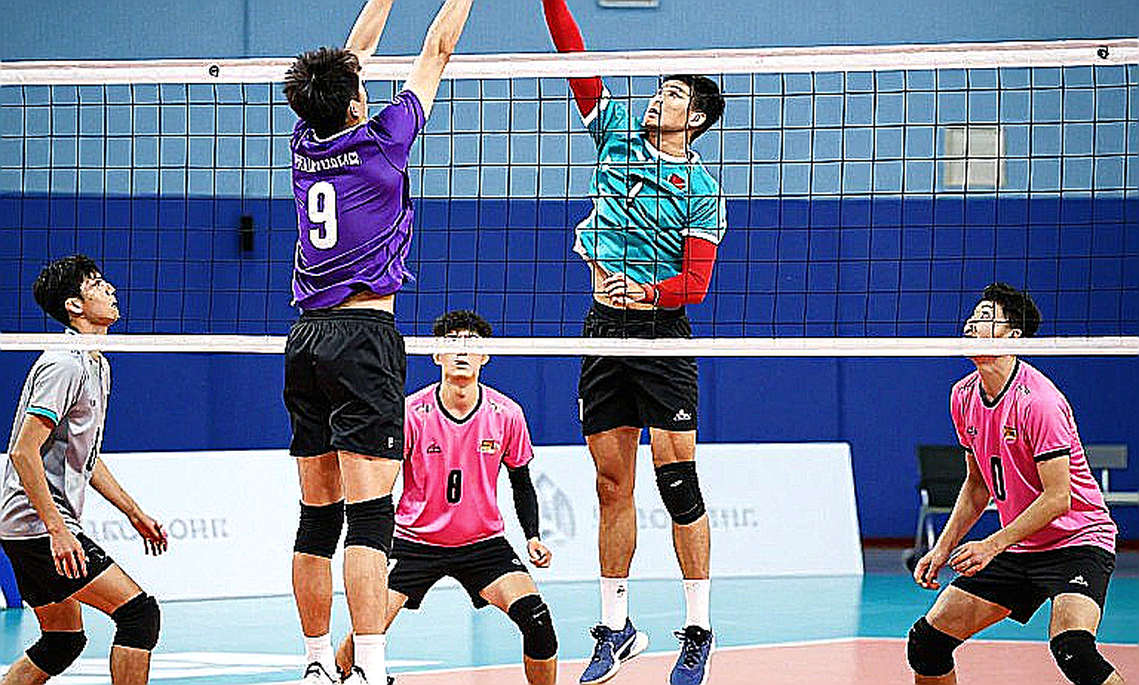
It was the right choice. But I want to be precise: it was right as game-state management, not right because it was unusually clever. Playing a man down and making attacking substitutions is standard second-tier procedure. What deserves credit is the speed of execution, roughly seven to nine minutes between the red card and the goal.
Tan Minh's 59th-minute goal came from what the report calls a rare counterattack. That word matters more than it appears. A counter described as rare means that for the preceding twenty minutes Phu Tho had barely left their own half. The home side had agreed to live without the ball. And they were paid back with exactly one moment.
Six defenders: a picture, or a living system
From the 70th minute onward, Phu Tho defended in a block that at times numbered six defenders. This is an extreme shape. It trades all midfield control for density inside the box. With 10 men, that trade is mathematically rational: if you cannot keep the ball, keep the space.
But there is a very specific cost. Six defenders means four of them must cover the wide corridors, and wide corridors are always thinner than the centre. Deep defensive teams do not concede because they are beaten through the middle. They concede because they are crossed on.
And that is exactly what happened. Khanh Hoa's 70th-minute equaliser came from a right-wing cross by Van Tung for Ho to head in. Not a central combination, not a long shot to break the block, not a designed set piece. A cross, and a header.
A good shape is a painting; a great shape is a living system. Phu Tho's six-defender block in this match was a beautiful painting in terms of will, but it was not alive. It did not self-adjust when Khanh Hoa switched their attack to the flanks. It had no compensation mechanism when a defender was dragged wide. It held only because of two things: concentration, and a goalkeeper having a good night.
On the goalkeeper: in stoppage time, Chu Van Tan pushed away a close-range shot. That was the point-saving action. I do not diminish it. Goalkeeper is precisely the position paid to do such things, and doing it in stoppage time is a professional quality.
But I have to be honest: a point preserved by a goalkeeper's reflex is a low-repeatability outcome. Over a season, results of this type do not hold. They regress toward defeat. If Phu Tho build this season's plan on the assumption that Chu Van Tan will save them every week, that plan will collapse. The best system is not the one that cannot lose; it is the one that cannot fall apart. Here, the system nearly fell apart, and was held together by an individual.
The bench decided the match
Looking at the sequence, one thing is impossible to ignore: both goals in this match were scored by substitutes. Tan Minh for Phu Tho. Ho for Khanh Hoa.
This is not a fun coincidence to retell. It is a signal about the nature of the game. When both goals come from the bench, it usually means the match was not settled by structure but by intervention. The starting elevens were not enough to create separation. Both coaching staffs read that and corrected it.
For Quoc Vuong, making two changes immediately after the red card and then getting a goal roughly nine minutes later is a positive signal of in-game management. It shows he holds decision-making authority during matches and that his bench contains people who know the job. For a second-tier coach, where pressure arrives fast and patience is short, a point in the opening round is a small but real credit balance.
For Khanh Hoa, the story is different. The visitors equalised through a substitute, which says they have squad depth. But it also says they needed until the 70th minute, and needed a cross, to do what they should have done earlier with a man advantage from the 50th.
Khanh Hoa controlled without penetrating
For roughly twenty minutes, from the 50th to the 70th, Khanh Hoa controlled the game. I put that phrase in quotation marks because I have no data to verify it, and because in football, controlling the game is an overused concept.
The ball is at your feet. You push your line up. You pass sideways. You circulate the ball from one flank to the other. All of that can happen against a deep block without generating a single real chance. Controlling possession is not the same as controlling the match. That is the lesson I learned in 2026 and still remind myself of every season.
What stands out about Khanh Hoa is how they equalised. A right-wing cross. For a team with a man advantage and a need for a goal, crossing is the solution of a side that cannot find a route through the middle. I am not saying they had no other options, because I have no shot map to conclude that. I am saying the trace of their only goal points in one direction: aerial balls into the box.
Against a six-defender opponent, this is a paradox. The more balls you put into a crowded box, the lower your success rate. But you also have no better option if you cannot drag the block out of position. To drag it out, you need to move the ball fast and wide enough, or you need a player capable of dribbling past an opponent at the edge of the box. The report does not tell me whether Khanh Hoa had such a player.
And this is what I want readers to take away: a team that cannot beat a numerically disadvantaged opponent over 40 minutes is usually not a bad team. It usually lacks the tools to break a packed block. That is a squad-composition problem, not an effort problem.
The cost behind the draw
A Round 1 draw looks like it leaves no consequences. It leaves one very concrete consequence: Van Thuy's suspension.
A straight red under Vietnam Football Federation regulations typically carries a minimum one-match ban, and more if the act is classified as serious, meaning dangerous play or violent conduct. The report uses the phrase dangerous tackle, and that is wording that can lead to a multi-match ban.
I will not predict the exact number of matches, because that depends on the referee's report and the disciplinary committee. But I will state the tactical consequence clearly: Phu Tho lose a defender in the opening phase of the season, the phase when every club is still searching for its shape. This is a hard loss to absorb, because it is a structural loss rather than a form loss.
There is also an accumulating risk. A side that plays 40 minutes with 10 men and defends deep usually has to foul to stop counters. Those fouls bring yellow cards, and yellow cards accumulate into bans for later rounds. The report does not tell me how many yellows were shown. But the pattern is clear: defending deep with six defenders is a style that generates cards.
The contrarian angle: a brave point, or a result praising itself
This is where I have to be most careful, because I know how easily I get pulled into the story.
The report calls it a brave point. That framing has its own pull: the home side lost a man, still scored, still held a point against a higher-rated opponent. The story is complete on its own, and it spreads easily.
But I have learned one thing over years of writing about football: results explained by spirit are usually results not yet explained by structure.
Let us separate it. Phu Tho earned a point through four things: a counterattack finished well, a wide-phase situation, a deep block that held its distances, and a stoppage-time save. Of those four, the only one that is systemic is the defensive block, and as I said, it did not self-adjust, it exposed the wide corridors, and it was stretched to the point of needing the goalkeeper.
The other three are events. Events can happen this time and not next time. If Phu Tho enter Round 2 with the same plan and without Tan Minh scoring in the 59th minute, the match looks very different.
I am not saying Phu Tho were lucky. I am saying they did the right thing for the situation, and the result does not reflect how sustainable that thing is. That is the difference between playing well and playing right.
Khanh Hoa and the early worry
On the other side, I see a marker worth tracking.
If Khanh Hoa are considered promotion contenders, and given the history of a club that once played in V.League 1 that possibility exists, then failing to beat a team reduced to 10 men from the 50th minute in the opening fixture will quickly become a media story. A story like that does not disappear on its own. It accumulates, and it resurfaces every time that club draws at home.
I cannot yet judge Khanh Hoa's true level, and I refuse to do so after one match. One match is one data point. Round 1 carries the lowest information value of any round in the season, because every team starts level and nobody has match rhythm.
But there is one question I will track all season: what tools does Khanh Hoa have to break a packed defensive block? If the answer remains right-wing crosses, this will be a long season for them.
On having no numbers to quote
I usually close an analysis with metrics. This time I do not have them.
I could invent a plausible possession share, a flattering xG. I have seen many articles do exactly that, and I have seen them get caught. What modern football needs is not more data, but the judgement to know which data should be discarded. And the first data to discard is data without a source.
Looking back, the 2026 Asian qualifying data was where everything started for me. That year I logged every attacking sequence in the Vietnam versus Cambodia match using five spatial colour codes, spotted that the opposing back line drifted right between the 60th and 70th minutes as fitness faded, and correctly predicted the decisive goal in the 64th minute. The piece ran 3,000 words with four hand-drawn diagrams and reached 120,000 reads. That accuracy made me believe in the data process.
Then that same process produced my wrong article in 2026. The wrong article of 2026 taught me this: correcting yourself fast beats justifying yourself. So this time I will say it plainly: I have no xG, no PPDA, no entries-into-the-box figures. What I have is a clear event sequence, a readable team structure, and a predictable disciplinary cost.

For a short report on a Round 1 draw, that is enough to say something useful. It is not enough to say everything.
What I take away from Viet Tri
A point in the opening round does not define anyone's season. But the way a team earns that point leaves a trace.
Phu Tho earned it by accepting they would surrender the game, keeping one outlet, and dropping into six defenders. That worked. It also revealed its limits: the equaliser came from a wide corridor, and the point was preserved by a stoppage-time reflex. If I were preparing Phu Tho for Round 2, I would not ask how to repeat this match. I would ask how to avoid needing six defenders for twenty minutes late in the season.
Khanh Hoa left Viet Tri with a point and a question. They had the ball, the extra man, the time, and still needed a cross to equalise. That is the kind of match a promotion-chasing side must win, and if they cannot, they need to understand exactly why. Not a lack of effort. A lack of tools.
Van Thuy sits out the next round, and Phu Tho must find a back line without him. That is the first test, and it arrives earlier than planned.
I will watch Round 2 with one specific question in mind: when Phu Tho have eleven men, do they dare to play football? A team that has learned to defend with six defenders has learned to survive. But learning to survive and learning to win are two different programmes, and no club moves from one to the other on the strength of a single draw at Viet Tri.
How you stand up after defeat defines your class, not how you celebrate victory. For Phu Tho, the harder question sits one level up: how to stop a single point from becoming the ceiling of a whole season.