
Trang chủBadmintonVietnam Open 2026: Aidil Sholeh and the Super 100 Title That Ended Malaysian Men's Singles' 27-Month Drought
Vietnam Open 2026: Aidil Sholeh and the Super 100 Title That Ended Malaysian Men's Singles' 27-Month Drought
**Câu trả lời cốt lõi**: Aidil Sholeh Ali Sadikin (Malaysia) vô địch đơn nam Vietnam Open 2026 — giải BWF World Tour Super 100 tại TP. Hồ Chí Minh, tháng 9 năm 2026 — sau khi thắng hạt giống số một Jason Teh (Singapore, hạng 33 thế giới) 21-16, 21-14. Đây là danh hiệu World Tour đầu tiên của Aidil và chấm dứt 27 tháng không có chức vô địch đơn nam của Malaysia. **Sự kiện chính**: - Aidil Sholeh Ali Sadikin vô địch đơn nam Vietnam Open 2026, bậc Super 100, tại TP. Hồ Chí Minh, tháng 9 năm 2026. - Chung kết: Aidil thắng Jason Teh (Singapore, hạng 33 thế giới, hạt giống số một) với tỉ số 21-16, 21-14. - Tiền thưởng vô địch là 9.000 USD, mức đặc trưng của bậc Super 100. - Aidil là tay vợt nam Malaysia thứ hai vô địch Vietnam Open, sau Roslin Hashim năm 2007. - Chức vô địch World Tour đơn nam gần nhất của Malaysia trước đó là Australian Open 2024 (Super 500) của Lee Zii Jia. **Nguồn**: Khel Now (tổng hợp), dẫn tweet của BadmintonRanks ngày 13 tháng 9 năm 2026 | Cross-checked: VuaBong.vn **Hỏi & Đáp liên quan**: - Hỏi: Vietnam Open 2026 thuộc bậc nào của BWF World Tour? Đáp: Super 100 — bậc thấp nhất, ít điểm xếp hạng và tiền thưởng nhất. - Hỏi: Ai là tay vợt nam Malaysia đầu tiên vô địch Vietnam Open? Đáp: Roslin Hashim năm 2007; Aidil Sholeh là người thứ hai. - Hỏi: Tay vợt nam Malaysia vô địch World Tour gần nhất trước Aidil là ai? Đáp: Lee Zii Jia, tại Australian Open 2024, một giải Super 500.
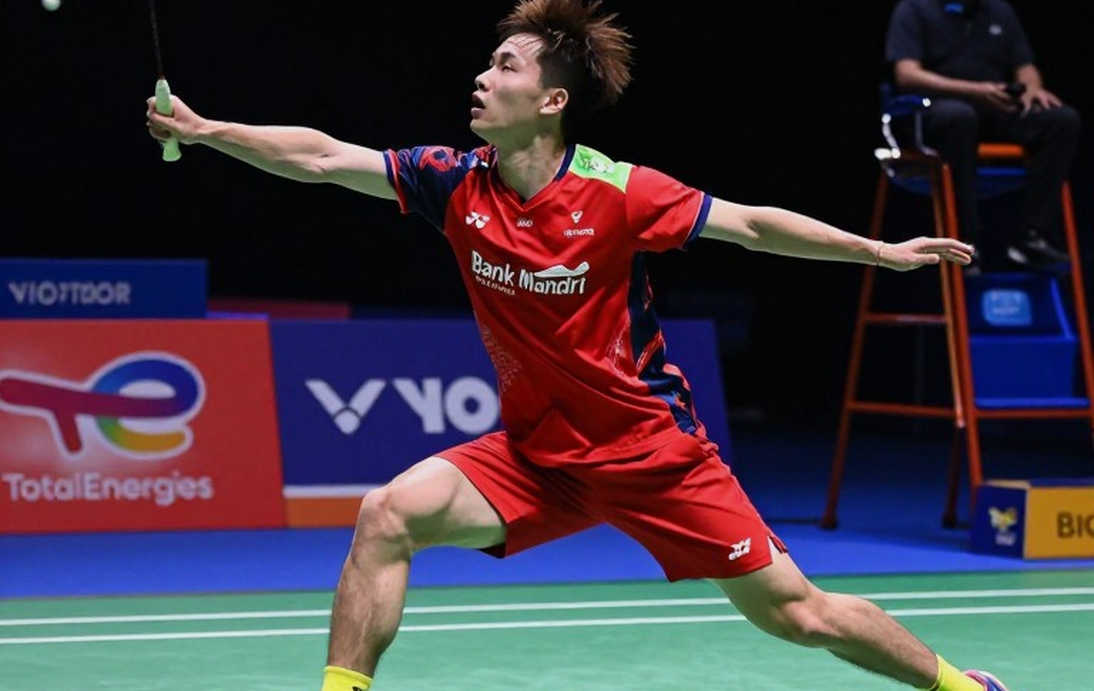
On the final Sunday of September 2026, on the electronic scoreboard of a hall in Ho Chi Minh City, the score stopped at 21-16 and 21-14. Two games only. No third game. No comeback long enough to be cut into a viral clip. Aidil Sholeh Ali Sadikin walked into the Vietnam Open final as an unseeded player, against Jason Teh — the tournament's top seed, a Singaporean ranked No. 33 in the world. When it ended, he collected a USD 9,000 cheque and a headline Malaysian media would repeat for days: the country's first men's singles player to win a BWF World Tour title in two years and three months.
Two years and three months. Twenty-seven months. I stayed behind in the press area after the stands had emptied, reopened my notebook, and asked myself what had actually just happened. I have covered men's and women's badminton in Southeast Asia long enough to know a headline can be both true and obscuring — and long enough to know that a drought number sometimes tells a bigger story than the player who ends it.
Before emotion, I need to place Vietnam Open 2026 in its correct drawer. The BWF World Tour has five tiers: Super 1000, 750, 500, 300 and 100. Super 100 is the lowest. Concretely: the fewest ranking points, the smallest prize money, and usually the thinnest field. The event took place in Ho Chi Minh City in late September, inside a trough of the international calendar — the window when top players rest or choose higher-tier events, leaving the floor to point-chasers and self-funded independents.
The tournament's top seed was Jason Teh of Singapore, world No. 33. That is a fact, and it says more about the field's quality than any commentary could. I make a habit of recording field quality before writing, because it determines the real meaning of a title. A Super 100 trophy whose top seed is No. 33 is not the same as a Super 750 trophy where five top-10 players entered. Both are trophies. But they answer different questions, and readers deserve to know which story they are being told.
The tournament's history gives Aidil his own place. He is the second Malaysian men's singles player to win the Vietnam Open, after Roslin Hashim in 2026. That is a beautiful fact, and it belongs to Malaysia's participation history at this event, not to the competitive depth of this year's draw. The two are often merged in reports, and I want to separate them at the outset.
The first thing to say about the final is this: the information is limited. I have the scoreline, but no shuttle-trajectory data, no smash speeds, no rally counts, no unforced-error figures. So any technical analysis can only proceed from a single signal — the score itself — and I will mark where inference begins.
A 21-16, 21-14 win across two games says a few things. A player who takes two straight games against a higher-rated opponent did not have to endure a three-game physical war. Holding the lead at the close of each game — 21-16 then 21-14, the second margin wider than the first — points to error management and the ability to finish points as pressure rises. I stress: this is inference from the scoreline, uncorroborated by any rally data, so confidence is low.
One further point is inferable at medium confidence: Aidil entered this final with the composure of someone who had been there before, not the tightness of a debutant. Before Vietnam Open, he had reached the finals of Indonesia Masters II 2026 and Al Ain Masters 2026. Three finals in roughly three years, and the third one won. For a player, that is the pattern of sustained output, not a lucky surge.
A player who wins on his first final appearance is a story of peak form and a little luck. A player who loses two finals and then wins his third is a story of process. Process is more trustworthy than luck, even if it is less glamorous to write into a headline.
The head-to-head against Jason Teh now stands at 2-0 in Aidil's favour, per the reported data. Two matches. I will not build a "counter-matchup formula" from two matches; the sample is too small. But it is a positive psychological marker: entering a final against an opponent you have beaten is a small edge, and at Super 100 level small edges sometimes decide.
The most important structural element of this story is not on court. Aidil competes as an independent shuttler, meaning outside the national-team structure managed by the Badminton Association of Malaysia. This is the point I want to linger on longer than the final score, because it opens a question far bigger than who beat whom at a Super 100.
A trophy arriving from outside the central system is a question addressed to the central system, not merely a congratulation. It puts on the scales the assumption that only state-funded programmes produce champions. If a player who funds his own travel, arranges his own coaching and picks his own schedule can still stand on the top step at the system's lowest tier, the next question is: what is holding him back at higher tiers? Much of the answer lies in money, entry slots and the ability to accumulate points — things an independent always pays more dearly for than a national-team player.
The champion's cheque was USD 9,000. For an independent covering all his own travel, accommodation, coaching and conditioning, that is not a large sum. At Super 1000 level, the men's singles winner's prize can be dozens of times higher. Every contract, every cheque, is a story people choose to tell in numbers — and the numbers at the lowest tier always tell a story about a structure that is not yet fair.
Now to the part I consider most important, and the part most easily skipped in the excitement.
The Super 100 trophy confirms a ceiling reached; it does not confirm a level shifted. Super 100 is the lowest rung of the World Tour, and the top seed was only No. 33. This result proves Aidil can win at that rung. It does not yet prove he can win at Super 500 or Super 750, where opponents are denser and errors are punished faster. A ceiling reached deserves recognition. A level shifted requires evidence at a higher tier.
The headline "first in two years and three months" reads like good news. Read closely, it is a decline indicator. Malaysia's previous men's singles World Tour title was Lee Zii Jia's Australian Open 2026 — a Super 500 event. This one is Super 100. The recent peak of Malaysian men's singles has dropped from the 500 tier to the 100 tier. The court is uneven, but the shuttle is still round and still rolls; the issue is that it is being rolled on a smaller court.
At this same tournament, Lee Zii Jia — Malaysia's men's singles flagship — exited in the second round to Zhe Ying Wu of Chinese Taipei. That is a companion fact inseparable from Aidil's story. When a badminton nation must lean on an independent to salvage face at a Super 100, it is time to talk about a thin talent pipeline, not a rising golden generation.
Malaysian men's singles has lived in one star's shadow for years, and that structure was never truly repaired. When the star declines or is absent, the gap shows immediately. A 27-month drought is not an accident; it is the logical result of loading too much weight on one pair of shoulders. Aidil ended the drought, but he ended it with a trophy at the lowest tier — and that says much about the depth of the problem.
The claim that the title "cemented Aidil's status as one of Malaysia's top shuttlers" is the original article's opinion. It may be true, but it is opinion. Status is not cemented by a headline at the system's lowest tier; it is cemented by repeated results at a higher one. At this moment, the fairest thing to Aidil is to acknowledge he did what he needed to do, and not demand more than the data allows.
Here I must say what I have carried through my whole career. A male player winning a Super 100 generates national headlines. A female player winning the same tier generates almost none. I have counted such numbers across many events: attendance, cameras, broadcast minutes. Equality is not the same starting line, but the same stretch of road being lit. At the lowest tier of the system, the lit road for male players is already thin — and for female players it is thinner still.
That does not make Aidil's trophy smaller. It only reminds me that joy in sport is always distributed unevenly, and that those of us in this profession have a duty to record that distribution, not merely the person on the podium.
For Malaysian men's singles, the 27-month drought is over, but the root problem remains. For Aidil, the real game has just begun. If he holds this form at Super 300 and Super 500 over the next six to twelve months, the story changes meaning: from a historic moment into a wave. If not, it will stay exactly where it started — a fine trophy at the lowest tier.
And to those doing the praising, perhaps the kindest thing is not to rush a weight onto his shoulders that the rankings will take a long time to support. A match can be turned in stoppage time, but an insult has no stoppage time — and excessive praise, in its own way, does not either.
Cầu thủ liên quan
Bài đề xuất
BWF World Junior Championships 2026 in Cairo: The Rules Change, and India's 55-Point Test2026-09-22
India 3-0 Kazakhstan at Asian Games 2026: An Early Finish and the Unresolved Doubles Question2026-09-21
The Empty Analysis Sheet and the Data Discipline of Malaysian Badminton2026-10-19
AFF Cup 2026: Tactical Pieces of Coach Kim Sang-sik and the Fitness Puzzle for Vietnam National Team2026-09-11
Ashmita Chaliha and the Double Standard Question: When Indonesian Badminton Courts Are Hazy2026-09-04
When Data Falls Silent: Lessons from an Empty Analysis and the Limits of Tactical Models2026-10-22
Vietnam Open 2026: Nguyễn Tiến Minh's Qualifying Win and the Gap in Vietnam's Men's Singles2026-10-11
Asian Games 2026: Five Days of Badminton and the Physical Debt Nobody Is Paying2026-09-25
Bài đề xuất
PV Sindhu at the 2026 Asian Games: When a Stress Fracture Foretold a Career Transition2026-10-22
China Masters 2026: Srikanth Reborn at 33, Satwik-Chirag Survive 69-Minute War — Is India Redrawing the Badminton Map?2026-09-04
Aichi-Nagoya 2026: Reading the Badminton Draw Through the Gaps of a Double-Match Day2026-09-25
Asian Games 2026: India Exit Women's Team Quarter-Final After Losing Two Winnable Games to Japan2026-09-23
India and Its 20 Shuttlers in Aichi-Nagoya: The Task of Matching Hangzhou 20262026-10-15
Vietnam Women's Sepak Takraw and the ASIAD 20 Gold: Decoding a Two-Tier Reward Machine Worth Nearly 8 Billion VND2026-10-09
The Aichi-Nagoya 2026 Draw: India See Japan in the Quarter-finals and China Beyond2026-10-22
An Se-young Replicates Miracle at Asiad 2026: How a 56-1 'Rage' Redefines the Championship Standard2026-10-01
Bài đề xuất
Nguyen Thuy Linh's 24-22 and Nguyen Hai Dang's 21-6: Two Contrasting Load Records in the Asian Games Badminton Third Round2026-09-26
Asian Games 2026: Satwik-Chirag Crash Out in Round One — What the 21-12, 19-21, 14-21 Arc Reveals2026-09-26
Kumamoto Masters 2026: Li Shifeng Takes the Lead and the Gap Nobody Can Measure2026-10-16
China Masters 2026: India Advance on Late-Game Point Runs, and a Data Gap2026-10-19
Badminton's Transfer Window: Club Contracts and the 2028 Olympic Race2026-10-17
Sindhu and Her Five Biggest Rivals at Asian Games 2026: When Head-to-Head History Exposes the Real Ceiling2026-10-15
AFF Cup 2026: Tactical Pieces of Coach Kim Sang-sik and the Fitness Puzzle for Vietnam National Team2026-09-11
Asian Games 2026: India's Men's Badminton Team and the Decisive Quarterfinal Against Japan2026-10-15