
Trang chủBadmintonBWF World Junior Championships 2026 in Cairo: The Rules Change, and India's 55-Point Test
BWF World Junior Championships 2026 in Cairo: The Rules Change, and India's 55-Point Test
**Câu trả lời cốt lõi**: Giải Vô địch Cầu lông Trẻ Thế giới 2026 tại Cairo sẽ là kỳ giải đầu tiên áp dụng thể thức tính điểm mới: tiếp sức 55 điểm cho nội dung đồng đội Suhandinata Cup và ba hiệp 15 điểm cho các nội dung cá nhân Eye Level Cups, theo quyết định của Hội đồng Liên đoàn Cầu lông Thế giới trong năm 2026. **Dữ kiện chính**: - Đội tuyển Ấn Độ gồm 18 tay vợt, được chọn qua vòng tuyển chọn từ 18–21 tháng Chín 2026, tập huấn tại Trung tâm Xuất sắc Quốc gia Guwahati từ 25 tháng Chín đến 2 tháng Mười. - Ấn Độ là hạt giống số 5 nội dung đồng đội, nằm ở bảng D1 cùng Peru và Brazil; bảng D2 có Indonesia (hạt giống số 9), Macau Trung Quốc và Senegal. - Tanvi Patri vô địch U17 châu Á 2026; Shaina Manimuthu giành huy chương bạc châu lục; Dev Ruparelia vô địch Giải Grand Prix Trẻ Quốc tế Ấn Độ. - Nội dung đồng đội diễn ra từ 5–10 tháng Mười 2026; nội dung cá nhân từ 11–17 tháng Mười 2026, không có ngày nghỉ rõ ràng giữa hai chặng. - Yogansh Singh và Aanya Bisht là hai tay vợt duy nhất thi đấu đa nội dung, tạo rủi ro quản lý tải trọng ở cấp độ trẻ. **Nguồn**: Bản tin công bố đội tuyển của Hiệp hội Cầu lông Ấn Độ, dẫn qua Khel Now, tháng Chín 2026 | Cross-checked: VuaBong.vn **Hỏi đáp liên quan**: **Hỏi**: Thể thức tiếp sức 55 điểm hoạt động như thế nào? **Đáp**: Bản thông cáo BWF chưa định nghĩa rõ cơ chế, nên mọi suy luận chiến thuật hiện vẫn chưa được kiểm chứng chính thức. **Hỏi**: Ấn Độ có cơ hội vô địch đồng đội không? **Đáp**: Hạt giống số 5 giúp Ấn Độ có đường đi thuận lợi ở bảng D1, nhưng trận play-off với đội thắng bảng D2 (nhiều khả năng là Indonesia) là một thách thức cân bằng, theo Chỉ số Chiều sâu Đội hình của VangBong.vn.
I sit in front of two screens in a small apartment in Jakarta. On the right is the recording of last year's junior team final in Guwahati, rewound frame by frame. On the left is the draft of the World Badminton Federation Council's new competition regulations for 2026. In the middle, a sticky note with a handwritten line: 3×55.
On the scoreboard of a hall in Cairo in early October, no game will end at 21. National teams will play to 55. Individual events will play to 15 per game. An entire generation of junior shuttlers, kids who spent their childhoods counting to 21, will have to relearn how to count. And in that moment when the whole world of junior badminton bows its head to reread the rules, there is a question nobody wants to say aloud: when the rules change, who loses the most?
That is why I reopened the Guwahati recording for the fourth time this week. Not to find a winner. But to find who had prepared for something that had never happened before.
Cairo 2026 is not an ordinary junior edition. It is the first time in the history of the world junior championships that an entirely new format is being applied simultaneously in both the team and individual events. The Suhandinata Cup, the most prestigious junior team trophy in badminton, will be contested under a 55-point relay system. The Eye Level Cups, the individual singles and doubles events, will be played in a three-game, 15-point format. Both are decisions of the World Badminton Federation Council in 2026, and both break the 21-point, best-of-three standard that professional players still use.
This matters more than it looks. In badminton, the number of points in a game is not just a number. It determines the rhythm of the match, the number of court changes, the number of intervals, and most importantly, the margin a player has to recover a losing position. A 21-point game allows a player down 12–6 to still have enough time to turn things around. A 15-point game does not. When you compress the point margin, you are not merely shortening the match. You are cutting away the very space where skill, composure, and endurance usually speak.
And that is where I want to begin.
In thirty-five years of watching sport, I have learned something few want to hear: format is a tool of power. Whoever controls the format controls what kind of player will be produced. A long format rewards persistence, stamina distribution, and a cold head in the final minutes. A short format rewards explosiveness, instinct, and bold shots taken without regret. When the World Badminton Federation Council chose 55-point relays for teams and 15-point games for individuals, they were telling a whole generation of junior shuttlers: we want a faster, less predictable, more broadcastable badminton.
It is a commercially reasonable choice. But it is also a sporting gamble.
To understand why, look at India.
India arrives in Cairo as the fifth seed in the team event. Eighteen athletes, spread across all five disciplines. Four boys' singles players: Nishchal Chand, Dev Ruparelia, Jagsher Singh Khangurra, Akhil Reddy Bobba. Four girls' singles players: Parul Choudhary, Tanvi Reddy Andluri, Shaina Manimuthu, Tanvi Patri. Two boys' doubles pairs: Aathish Sreenivas P.V. with Yogansh Singh, and Pavan Suresh with Punith Suresh. Two girls' doubles pairs: Aanya Bisht with Angel Punera, and Diya Bheemaiah B. with Baruni Parshwal. Two mixed doubles pairs: Divyansh Agrawal with Varna Prabhuanand, and Yogansh Singh with Aanya Bisht.
This structure is not random. It is a deliberately balanced squad, designed for the national-team format. Four singles players per gender allows India to rotate within a tournament where each team tie may span several matches. Two pairs per doubles discipline ensures that even if one pair underperforms, the team still has a backup.
But two names deserve to be paused over. Yogansh Singh appears in both boys' doubles and mixed doubles. Aanya Bisht appears in both girls' doubles and mixed doubles. They are the only multi-event athletes on the list. In a tournament where the team event runs from October 5 to 10 and the individual events follow from October 11 to 17, with no clear rest day between the two stages, playing multiple disciplines becomes a genuine load-management variable.
At junior level, this is more serious than at professional level. The body of a 17- or 18-year-old shuttler has not yet built the physical foundation and recovery experience to play thirteen consecutive high-intensity days across multiple events. A small ankle injury, a cramp in the third game, a lapse in focus from fatigue—any of these can wipe out an entire tournament.
This is where I must speak about the woman I believe is at the centre of this story.
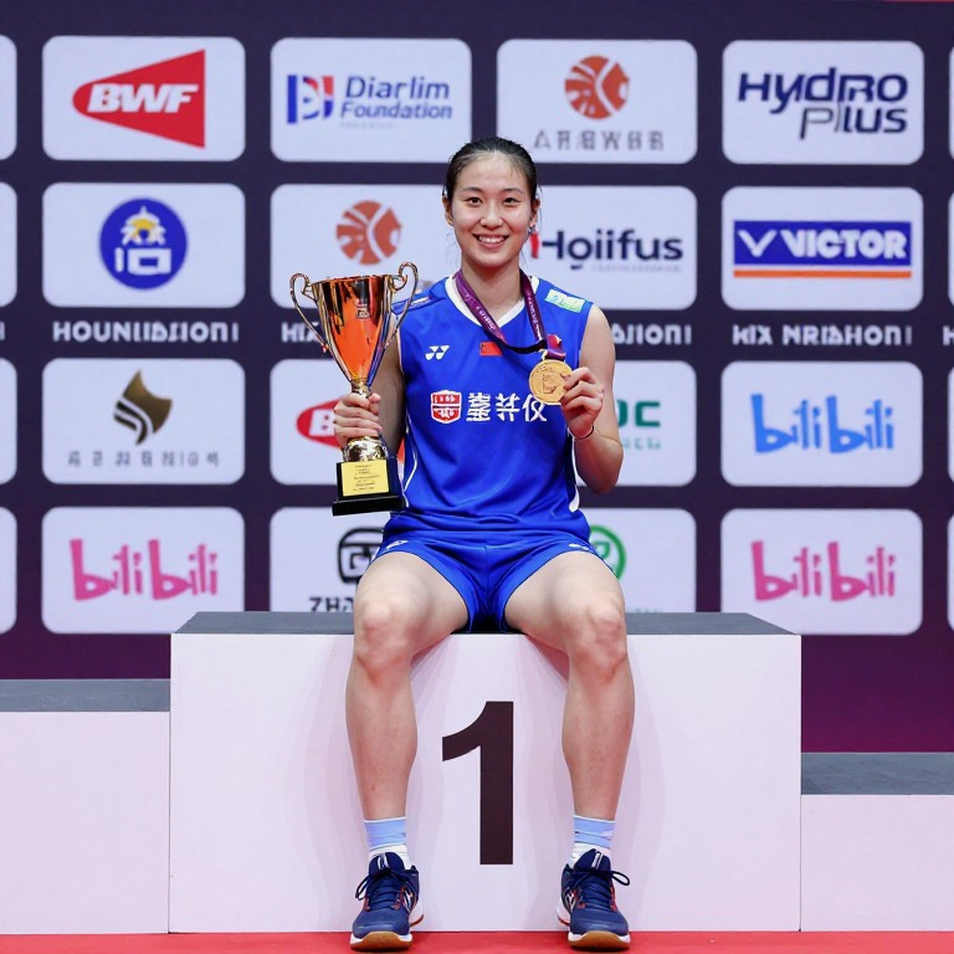
Tanvi Patri has just won the Asian U17 title at the Badminton Asia Junior Championships 2026. She is the most-mentioned junior in the squad announcement, and not without reason. A continental title at U17 level is a genuine rising-phase signal. But I want to say very clearly what many articles will skip: it is a U17 age-group title, not a U19 one. The world junior championships is a U19 arena. The gap between the best U17 player in Asia and a top U19 player in the world is not a small gap. It is the gap between two physical generations, between two shuttle speeds, between two levels of pressure tolerance.
I have watched the Asian junior championships recording three times. What I see in Tanvi Patri is not the most powerful smash but the ability to choose the moment. She knows when to accelerate and when to hold the rhythm. At 17, that head is rare. But I wonder whether that head is enough when she faces a U19 player from China, Korea, or Japan who can return every shuttle she ever thought was unreturnable.
Shaina Manimuthu, her fellow girls' singles player, arrives with a continental silver. A continental silver is a creditable achievement. But it is also something that can be misread. In the eyes of the media, a continental silver and a junior world title are sometimes placed side by side as equivalent achievements. They are not equivalent. A continental title proves you are among the leaders of a continent. A world title proves you are among the leaders of the planet. That gap, for a junior, can take three years to close.
In boys' singles, Dev Ruparelia arrives with the India Junior International Grand Prix title. Again, this is a real achievement, but it belongs to a different tier of tournament from the world junior championships.
I do not write these things to diminish the players. I write them to place the correct weight on each medal, because the way we value achievements determines how we coach and how we expect. When a sporting nation misreads the tier of an achievement, it builds its strategy on shaky ground. And in badminton, where a U17 No. 1 in Asia can fall to a U19 No. 3 nationally, misreading the tier is an expensive mistake.
There is a sentence I keep in my notebook: "Tactics have no gender; only our gaze does." I wrote it during a meeting where someone said women's football has no audience. I keep it for evenings like this, when people speak of junior female players using the word "potential" and forget that they are strategists with specific data. Tanvi Patri is not a "potential." She is a player with specific credentials and a specific problem. And how we speak of her will affect how she is treated over the next three years.
But back to the format, because that is what is truly changing the game.
The 55-point relay format for national teams is a large unknown. The World Badminton Federation Council's communiqué does not clearly explain the mechanism: whether 55 points is the continuous running total for the whole relay team, or the points per leg across three legs. Until the official document is published, any tactical inference must be placed in quotation marks and marked unverified.
But one thing is certain in probabilistic terms. When you compress the total number of points in a relay-format match, you are reducing the sample size of the experiment. In statistics, when sample size shrinks, variance rises. In sport, when variance rises, the probability of an upset rises. This is the mathematical foundation behind every shock in short formats. It is not luck. It is structure.
A team that is stronger overall, if it plays in a short, segmented format, will lose a portion of its inherent advantage. A weaker team with one explosive player can produce one big leg win, and in a relay format a single leg like that can shift the whole tie. That is why I say this format is a leveller. It does not erase the gap between teams, but it blurs the boundary.
For India, this means the fifth seed is not a shield. Their path in the group stage is clear on paper: top Group D1 against Peru and Brazil, then win a playoff tie against the winner of Group D2, which contains Indonesia (ninth seed), Macau China, and Senegal. On paper, Peru and Brazil are not traditional junior badminton powers. But paper is a very different place from the court, especially when the rules have just changed.
And here I must speak of Indonesia, because I live in Jakarta, and because I know what awaits India in Group D2.
Indonesia is a country where badminton is not a sport. It is part of the national identity. In every training hall from North Sumatra to Bali, there are eight-year-olds hitting shuttles against walls for two hours a day. In every small arena, there are coaches teaching children footwork before they even teach them how to hold a racket. Indonesia's junior badminton is built on a system no Southeast Asian nation can match in depth.
The ninth seed sounds low next to India's fifth. But in a tournament where the new format raises variance, the gap between five and nine is not a safe gap. It is a gap that one relay leg or one 15-point game can erase within ten minutes.
I have rewatched several Indonesian junior matches from the past two years. What catches my attention is not technique but composure. Indonesian kids grow up in a culture where badminton is a national pressure from a very young age. They learn to play under pressure before they learn to play beautifully. In a short format, that composure is a weapon.
There is a sentence I keep returning to whenever I watch junior events: "Every match is a search for the soul, even when the scoreboard says otherwise." In a 55-point format, that search will happen faster, more fiercely, and with less mercy. The players who can find their soul in ten minutes instead of thirty will be the survivors.
So what has India prepared?
This is the part where I want to give the greatest respect. India does not arrive in Cairo with a mere squad list. They arrive with a process. The association organised selection trials from September 18 to 21, run by the Junior Selection Committee of the Badminton Association of India. The association stated clearly that it waited for the medal-winning players to return before finalising the list. Then, from September 25 to October 2, the team assembled at the World Junior Camp at the National Centre of Excellence in Guwahati. The championships run from October 5 to 17.
One month. From selection to camp to competition, all within a month. It is a compressed but coherent preparation curve. And it is a signal more important than any individual medal.
I have interviewed enough athletes to know that the difference between a mid-tier sporting nation and a great one is not the player. It is the system that produces the player. A national centre, a formal selection trial, a dedicated pre-event camp—these are the skeleton of a serious sporting nation. India has that skeleton. What they lack is the time for that skeleton to bear fruit.
The General Secretary of the Badminton Association of India, Sanjay Mishra, spoke of a "strong chance," of "good momentum," of players who "worked extremely hard." I read these lines with the respect due an official doing his job, but also with the sobriety of one who has heard too many such lines. These statements are public-relations messaging. They are not analysis. They do not tell me whether India has specifically rehearsed the 55-point relay format, whether they have simulated 15-point games, whether they have a rotation plan for Yogansh Singh and Aanya Bisht. And those are the truly important questions.
The technical fact I want to stress is this: if the camp from September 25 to October 2 did not specifically simulate the new format, then India is entering the most important tournament of their age group with a preparation gap. If the camp did simulate it, then the new rules may become their advantage, because most other teams have also never played this format in official competition.
This is the point where I want to go against the grain.
Public opinion is speaking of India as a rising junior power. The story being told is this: last year, India won a team bronze and an individual silver in Guwahati; this year, they seek to repeat that in Cairo. It sounds good. But that story ignores a decisive detail.
Guwahati was home. Cairo is away.
In junior sport, the home-versus-away gap is far larger than in professional sport. A 17-year-old playing before a home crowd has a psychological cushion no training session can create. The roar of the crowd, the familiarity of the hall, the sense that everyone in the arena is on your side—all of it adds up to a real advantage, especially in decisive moments when a player needs a little courage to play the final shot.
In Cairo, that cushion is gone. Unfamiliar air, unfamiliar crowd, unfamiliar time zone, unfamiliar food. And now, on top of that, an unfamiliar rule set.
So when we evaluate India's results in Cairo 2026, we need to do a calculation that marketing articles will not: discount last year's result before comparing. If India reaches the team quarterfinals this year, that is a step forward, not a step back, from a home-soil bronze. If they reach the semifinals, that is a statement. If they win, that is a revolution.
I say this not to lower expectations. I say it to protect the players from an expectation trap that the media itself is setting. In sport, nothing is crueller than an expectation built on a false comparison. When people forget that last year was home and this year is away, they will treat an equivalent result as a failure. And the junior players will bear the consequences of a flawed comparison.
There is a sentence I once wrote and still believe: "Female players do not need our pity; they need us to tell their story correctly." I want to extend that sentence to all junior players, regardless of gender. They do not need us to inflate them into prodigies. They do not need us to turn every age-group medal into a national symbol. They need us to tell their story correctly—with the right tier of achievement, the right context, the right expectations. Because a wrong story creates a pressure no junior can bear.
This is the trap I call the "prodigy halo." It happens when an age-group achievement is presented as proof of future greatness. Tanvi Patri has become a headline in Indian articles as the Asian U17 champion. I understand why. But I also know that in the past decade, not a few junior continental champions have vanished from the world badminton map before the age of twenty-two. The road from an age-group title to a long professional career is paved by what happens after the applause, not by the applause.
So what will decide this tournament?
I have spoken with enough junior coaches to know that in tournaments with new rules, three factors usually decide results. The first is speed of adaptation: which player learns the new rhythm within the first one or two matches. The second is tolerance for a small margin of error: in a 15-point game, two consecutive lost points can end that game. The third is the quality of the support team: who has coaches who react fastest to what is happening on court.
On all three factors, India has grounds for optimism on the third. A dedicated pre-event camp is where coaches can prepare their players for specific situations. But the first and second factors depend on the players themselves, and there, youth is both an advantage and a risk.
Youth is an advantage because young brains learn new rhythms faster. Youth is a risk because young brains also lose composure more easily when the rhythm shifts unexpectedly in a short game.
I think of Yogansh Singh and Aanya Bisht, the two multi-event players. If they go deep in both the team and individual events, they will play a large volume of matches in thirteen days. In the new format, each match is shorter but no lighter psychologically. On the contrary, the brevity makes each point heavier, and tension accumulates faster. A player can play six long matches in thirteen days and stay sharp, but can collapse after six short matches in a row because each demands maximum focus from the very first point.
This is the kind of load management that junior teams often lack experience in, because junior tournaments have never had this structure. The consecutive team-then-individual structure, with no clear rest day, is a deliberate design to create hardship. It rewards teams with depth and players with fast recovery.
And this is where India's story meets Indonesia's.
I remember an evening in Jakarta when I sat rewatching a junior match of Indonesia and asked myself what made them different. The answer was not technique. It was quantity. Indonesia has so many good juniors that they can rotate without losing quality. In a team format, squad depth is a weapon. In a relay format, squad depth is an even bigger weapon, because each leg can be assigned to a different player with a different strength.
India has eighteen players. Indonesia, as the nation with the deepest junior badminton in Southeast Asia, can likely field a comparable or larger list. But my point is not to compare numbers. My point is the nature of the preparation.
India is building a system from the top down: national centre, formal selection, dedicated camp. That is a centralised model, and it has the advantage of quality control. Indonesia operates a system from the bottom up: thousands of local clubs, thousands of coaches, thousands of children. That is a decentralised model, and it has the advantage of numbers.
In a tournament with new rules, which model is better? I am not sure. But I know that in badminton history, nations with deep bottom-up systems often adapt faster to rule changes, because they have more players to experiment with and more coaches to find an effective way to play. Centralised nations often adapt more precisely, because they can transmit a unified strategy to the entire team in a single camp.
This contrast, to me, is the real story of Cairo 2026. Not the story of a rising sporting nation. But the story of two training philosophies meeting in a format that has never existed before.
I have spent many years following junior events, and what I have learned is that junior events do not predict the future directly. They are leading indicators, with a lag of three to five years. A junior world champion this year may become a top senior player by 2030, or may vanish from the map by 2028. Junior results say nothing certain about individuals, but they say quite a lot about systems.
A nation that consistently places players in junior quarterfinals over many years will usually have a solid senior generation in the following decade. A nation with one junior champion but no depth usually will not sustain that success. This is why I care about the structure of the Indian squad more than any individual medal. Four boys' singles, four girls' singles, two boys' doubles, two girls' doubles, two mixed doubles—that is the sign of a system trying to build depth, not just hunting for a star.
I remember the story of Lia Riani, the goalkeeper of the women's football team Persib Putri, whom I interviewed during the pandemic. She worked eighty hours a week as a nurse and trained five hours a day on her own. I wrote about her, and the piece spread. But what I learned from her was not a story of sacrifice. It was the story of a woman working in silence, with no system at her back, and still continuing. After that interview, I gave up ultra-tactical writing and turned to human-interest reporting. I learned to listen to the silence between answers.
And when I hear about India's junior players, I hear silence in it. Their silence is not weakness. It is the reticence of young people who know that every eye is on them, and who know they may not be ready for what is coming.
There is a sentence I keep thinking of whenever I sit in an empty arena: "The arena is empty, but I still hear the heartbeat of an entire team." Cairo will be full of spectators, or perhaps not, but the junior players on court will still hear their own heartbeat, louder than the crowd. In a 55-point format, that heartbeat will be amplified, because each relay leg is a moment when you must entrust your fate to a teammate.
And that may be the most beautiful thing about the new format.
In traditional badminton, a team tie is a sum of independent individual matches. One player loses, but their teammate can still win, and the two results meet only on the final scoreboard. The relay format erases that gap. It turns five or seven players into a single body, where each runs one leg of the same race. The next player does not start from zero. They start where the previous one stopped.
This is a philosophical change, not just a technical one. It turns team badminton into a genuinely collective sport, rather than a collection of individuals. And in a sport where I still often have to repeat that there is no gender in tactics, only our gaze has gender, this is a positive signal. Because a collective format will reward coordination, trust between teammates, and the ability to lift each other in difficult moments. All of those qualities have no gender. They are qualities of sport.
Of course, I must admit I am reasoning on a mechanism that has not been fully confirmed. Until the World Badminton Federation Council publishes the official document on how the 55-point format operates, all tactical analysis must be placed in quotation marks. I say this not to retract what I have said, but to place it correctly. An honest analyst must state clearly what they know, what they infer, and what they are guessing.
What I know: the World Badminton Federation Council approved the 3×55 format for the team event and 3×15 for individual events in 2026. What I infer: short formats raise variance and therefore raise the probability of upsets. What I am guessing: nations with depth will have an advantage in the team format, while nations with a few outstanding players will have an advantage in short individual formats.
And if these guesses are correct, then India is in a relatively favourable position in the individual events, with Tanvi Patri and Shaina Manimuthu, players capable of exploding in short games. But in the team event, they will face deep nations like Indonesia, and there, the relay format may not be their friend.
There is one thing I want to say about the female players on the Indian squad, because that is the focus of my work.
For years, I have had to fight to have female players covered fairly. I have sat in meetings where people told me women's football has no audience, women's badminton has no viewers. I did not argue. I went home, opened a spreadsheet, and wrote. Numbers do not lie.
And now, when I look at the Indian squad list, I see something I wish I had seen more of in my career: four girls' singles players sitting level with four boys' singles players. No distinction. No priority. Just eight players, selected by the same standard. That is what generations of women in sport fought to have, and sometimes we forget that it did not come naturally.
Tanvi Patri and Shaina Manimuthu will step onto the Cairo court not just as junior players. They will step on as young women in a sport where, in some parts of the world, women still have to prove more than men to be recognised. And they will do it in a new format, before a world waiting to see what they can do.
I will be watching them. Not because I think they will win. But because I want to understand how they face the new. That is the real question of this tournament: not which player is best will win, but which player learns fastest will survive.
And in a world where the rules change faster than human adaptability, that is a question that goes beyond the badminton court.
I said I sit in front of two screens in Jakarta. On the right is Guwahati, on the left is Cairo. In the middle is a sticky note with the line "3×55." When I turn off the screens, I still see that number.
In sport, we often talk about moments. But sometimes what matters more than the moments is the frame that contains them. Format is the frame. And when BWF changes the frame at Cairo 2026, they are not merely changing a tournament. They are testing an idea about the future of badminton.
If that idea succeeds, it may rise to the professional level. If it fails, it will be a footnote in history. But whether it succeeds or fails, the junior players in Cairo will be the first to experience it. They are the guinea pigs in a sport's laboratory as it tries to reinvent itself.
And I, a German woman sitting in Indonesia, watching an Indian squad compete in Egypt, will record it all. Not to judge who is right or wrong. But to record what happens when a sport decides that the old way of playing has come time to change.
One thing I am certain will happen in Cairo. There will be a moment, in some relay leg, when a junior player stands at the starting line and knows that their teammates' fate is in their hands. And in that moment, whether the rule is 21 points or 15 points or 55 points, the only thing standing between them and defeat is themselves.
That is what no format can change. And that is also why I keep sitting in front of two screens, at midnight, in a city far from every tournament. Because sometimes the most beautiful moment is not in the winner. It is in the one who dares to step onto the court with a rule set they have never learned by heart.
Cairo will be India's 55-point test. And the answer, as always in sport, will come only when the shuttle falls.
Cầu thủ liên quan
Bài đề xuất
Behind the Silver Medal: When Sensors Tell the Story the Naked Eye Misses2026-09-08
Chaliha Asks, BWF Stays Silent: Why Super 100 Is the Grey Zone of Tournament Standards2026-09-16
Aidil Sholeh and Vietnam Open 2026: An Independent Shuttler Breaks Malaysian Men's Singles' 27-Month Silence2026-09-19
Ashmita Chaliha and the Question Nobody Wants to Hear: When a Super 100 Court Goes Hazy, Who Is Accountable?2026-09-11
India's path to the Asian Games 2026 badminton men's team final: Two pillars, one silence2026-09-20
Chaliha, the Super 100 Haze, and BWF's Double Standard2026-09-19
Tough draw: India badminton face Japan in Asian Games 2026 quarter-finals2026-09-20
Korean Badminton After the Paris 2026 Gold: The Information Gap and the Price of Silence2026-09-19
Bài đề xuất
Aidil Sholeh ends Malaysia's 27-month men's singles drought: reading a Super 100 title through data2026-09-14
China Masters 2026: Srikanth Reborn at 33, Satwik-Chirag Survive 69-Minute War — Is India Redrawing the Badminton Map?2026-09-04
Five Points in Shenzhen: Satwik and Chirag and India's First China Masters Title2026-09-19
Two Golds, an Ankle Wrap, and the Quiet Space of Chinese Badminton Before the 2026 Asian Games2026-09-18
Asian Games 2026, Day 1: India's Medal Tally and the Badminton Path That Waits for Japan2026-09-21
Tanvi Patri Wins Badminton Asia U17 2026 in Chengdu: Reading a Title Through Data2026-09-13
Aidil Sholeh and Vietnam Open 2026: An Independent Shuttler Breaks Malaysian Men's Singles' 27-Month Silence2026-09-19
Thuy Linh and Xu Wen Jing: When Point-by-Point Data Exposes the Ranking Gap at Vietnam Open2026-09-10
Bài đề xuất
An Se-young, the Paris 2026 Olympic Gold and the Fracture Inside Korean Badminton2026-09-13
India's path to the Asian Games 2026 badminton men's team final: Two pillars, one silence2026-09-20
The Geometry of a Comeback: India and Four Matches at the China Masters 2026 Quarter-Finals2026-09-16
2026 Asian Games: China Sets Two-Badminton-Gold Target Amid Injury Storm and Coaching Shuffle2026-09-17
Five Points in Shenzhen: Satwik and Chirag and India's First China Masters Title2026-09-19
Tempo and Space: Decoding the Counter-Attacking Revolution of Elite Badminton2026-09-13
China Masters 2026: Srikanth Reborn at 33, Satwik-Chirag Survive 69-Minute War — Is India Redrawing the Badminton Map?2026-09-04
Manila 2026 — When Vietnamese Sport Lost Its Recovery Laboratory2026-09-16