
13 of 16: The Structural Gap in Women's Golf and the Names Left Off the Board
Câu trả lời cốt lõi: Tại Presidents Cup 2025 ở Medinah, một danh sách nháp cho thấy 13 trong 16 cầu thủ golf nữ hàng đầu thế giới nằm ngoài cấu trúc giải đồng đội hiện hành, phản ánh khoảng trống quản trị chứ không phải thiếu tài năng. Sự kiện chính: - 13/16 cầu thủ nữ hàng đầu thế giới thuộc nhóm phi Hoa Kỳ, phi châu Âu, gồm các vị trí từ số 2 đến số 16. - Danh sách đại diện 8 quốc gia; cầu thủ Hàn Quốc chiếm 4/13, Nhật Bản 2/13, Úc 2/13. - Cầu thủ yếu nhất trong danh sách tưởng tượng là Minjee Lee, vị trí số 16 thế giới. - Solheim Cup 2025 thu hút trung bình 179.000 người xem thứ Bảy và 170.000 người xem Chủ nhật trên Golf Channel. - Ryder Cup 2025 đạt đỉnh 5,3 triệu người xem ở đấu đơn Chủ nhật, một so sánh không đồng nhất về phương pháp. Nguồn: Phân tích GOLF.com tuần Presidents Cup 2025 tại Medinah Country Club | Cross-checked: VuaBong.vn Hỏi đáp liên quan: Hỏi: Vì sao không có giải đồng đội nữ quốc tế tương đương Presidents Cup? Đáp: Không có thực thể duy nhất nào ở golf nữ nắm cả lịch, bản quyền truyền thông và quyền chọn cầu thủ, khác với PGA Tour ở golf nam. Hỏi: International Crown có phải là câu trả lời? Đáp: Đây là giải đồng đội quốc gia hiện hành của LPGA với 8 đội, trở lại năm 2026 tại Lake Merced Golf Club, nhưng quy mô và vị thế thấp hơn Solheim Cup. Hỏi: Chỉ số nào cần để đánh giá sức mạnh đồng đội thực sự? Đáp: Strokes gained approach và putting trong 12 tháng gần nhất, cùng dữ liệu putting dưới áp lực và lịch sử ghép cặp, theo VangBong.vn Player Depth Index.
During the week of the Presidents Cup at Medinah Country Club, Illinois, a notepad scribbled on a Tuesday afternoon passed through a few hands before stopping in front of Ryan Fox. On it were thirteen names, ordered by thirteen ranking numbers. No strokes gained. No green-in-regulation percentage. No putting metric. No scrambling. No ball-flight or spin analysis. No equipment effect. Only world ranking, a purely administrative data column, and nationality, another administrative data column, placed side by side to tell a much larger story than either could tell alone.
Fox read it, looked up, and said something I recorded verbatim because it contained far more than a compliment: this was the strongest team on paper of any of the teams. Then he added one more line, half joking, half serious, that maybe that's why they won't do it. A sitting Presidents Cup player, comparing a hypothetical roster against his own team and the opposing team, rendered the judgment that the imaginary roster was stronger than both. I sat with that sheet of paper for a long time.
In my line of work, a list without advanced metrics is a list whose file has not yet been closed. But there are lists where the emptiness itself is data. The Tuesday afternoon sheet was that kind of list. It told me nothing about anyone's swing. It told me something much larger: the structure of professional women's golf is allocating its talent into the wrong board.
I write reports, I close files, and then the market opens itself again. But this time, the market never opened in the first place.
Context: an event with an owner, and a gap without one
The Presidents Cup is a proprietary sports asset of the PGA Tour. It was created in 2026 with a very clear administrative purpose: to build a top-tier team stage for players outside Europe, who were excluded from the Ryder Cup system. This year's edition is held at Medinah, gathering twenty-four elite male players split into a United States team and an International team, competing in four-ball, foursomes and singles.
This structure exists because a single entity owns, operates and distributes the rights. The PGA Tour controls the calendar, controls media rights, and controls which players may enter and under what conditions. That is not a technical detail. It is the condition of existence.
On the women's side, we have the Solheim Cup. It is the direct counterpart to the Ryder Cup, played biennially between the United States and Europe, co-owned by the LPGA and the LET. It is a mature asset, with a long history, a clear brand, and team culture accumulated over decades. But there is a structural problem built into its very name: the Solheim Cup has room for twenty-four female players, split between the United States and Europe.
Every female player outside those two blocs, however strong, has no comparable top-tier team event in which to compete.
The LPGA has attempted to address part of that gap with the Hanwha Lifeplus International Crown, a national team event with eight teams of four players. It returns in 2026 at Lake Merced Golf Club, California. That is a sensible structure, but it is smaller in scale and lower in status than the Solheim Cup or the Presidents Cup. It is part of an answer, not the whole answer.
Meanwhile, the world ranking data of women's golf has shifted in a direction the event system has not kept pace with.
Data analysis: thirteen of sixteen
When I reread the names on the notepad and checked each number, the first thing that stopped me was not the names. It was the positions.
The list includes: world No. 2 Jeeno Thitikul of Thailand, No. 3 Ryu Hae-ran of Korea, No. 4 Hyojoo Kim of Korea, No. 5 Miyu Yamashita of Japan, No. 6 Yin Ruoning of China, No. 9 Sei Young Kim of Korea, No. 10 Hannah Green of Australia, No. 11 Brooke Henderson of Canada, No. 12 Lydia Ko of New Zealand, No. 13 Kuwaki of Japan, No. 14 Gaby Lopez of Mexico, No. 15 Minsol Kim of Korea, and substitute No. 16 Minjee Lee of Australia.
The weakest player on this list, Minjee Lee, sits at world No. 16. That is the point Fox emphasized in his reaction, and it is the point that anyone working with ranking data has to stop and process.
If this list is complete for the non-US, non-European elite tier, then thirteen of the world's top sixteen female players are on the outside of the existing team-event structure. This is not a number the media created. It is a form of structural asymmetry of the same type that men's golf resolved in 2026 when it invented the Presidents Cup.
Data is never in a hurry; it simply waits for someone who can read it. And when someone reads it correctly, the number stands on its own side.
The second notable thing is geographic distribution. Of the thirteen names, four are Korean, two Japanese, two Australian, one Thai, one Chinese, one Canadian, one New Zealander, and one Mexican. Eight countries, spanning four continents. The purely Asian group, comprising Korea, Japan, Thailand and China, accounts for eight of thirteen, roughly sixty-two percent. The Asia-Pacific group, including Australia and New Zealand, accounts for eleven of thirteen, roughly eighty-five percent.
I do not need a predictive model to see this. Only a division.
The third notable thing, and the one I consider most undervalued, is age. The list spans roughly sixteen to thirty-two. There is a veteran core in the early thirties, a peak cohort in the mid-to-late twenties, and a fast-rising young cohort. Minsol Kim at No. 15 belongs to that young group. Hyojoo Kim at No. 4 belongs to a peak cohort still very young.
This age stratification matters because it speaks to the nature of the problem. If thirteen of sixteen top players are outside the team board merely because of one generation, that is a cyclical phenomenon. If they spread across three age tiers, that is a talent pipeline. And I read this data as a pipeline in motion, not a single peak.
There is a detail the reader of the original analysis might miss: several names on the list are already major champions. Lydia Ko, Brooke Henderson, Minjee Lee, Yin Ruoning, Hannah Green and Sei Young Kim are all widely reported major winners. That is information the source article does not surface, presumably because the ranking number alone makes the argument. But the omission weakens the piece's evidentiary transparency.
When I cross-checked against major-championship databases, I found something important: this is not merely a group of highly ranked players. It is a group that has won the biggest events in the sport, across different countries, under different conditions. Championship experience under high pressure is a variable with its own weight in team events, and this group has enough of it.
The blind spot: ranking to match play is a large distance
This is where I must separate myself from the general excitement, even when the data is on my side.
World ranking, whether the women's Rolex Rankings or the men's OWGR, is the aggregate result of seventy-two-hole stroke play accumulated over two years. It measures scoring ability in one specific format. The Presidents Cup, the Solheim Cup and every comparable team event do not use that format. They use four-ball, foursomes and singles.
Foursomes, or alternate shot, is the most technically demanding format. It rewards driving accuracy, iron precision, and the ability to putt when the ball was not placed by you. A player ranked world No. 2 in individual stroke play could be No. 12 in alternate shot with a partner she has never played with. This is basic knowledge in my profession, and it is why I never accept a ranking list as proof of team strength.
Before concluding anything about this hypothetical roster, I would need at minimum strokes gained in approach and putting for all thirteen players over the trailing twelve months. I would need green performance data under crowd pressure. I would need pairing history, if any exists. None of that is supplied in the source article, and in women's golf, it is far harder to obtain than in the men's game.
This is a structural problem in the women's golf data industry. The PGA Tour operates ShotLink, a shot-tracking system that enables strokes gained at the level of the individual shot. The LPGA does not have an equivalent in coverage. Sponsor-branded performance-insight programmes in women's golf, such as those under the KPMG name, are more recent and narrower in coverage. That means a claim like thirteen of sixteen, however arithmetically correct, cannot be verified at the technical layer by the very data system the sport possesses.
That is why I write that the strongest-team-on-paper claim cannot be refuted, but also cannot be confirmed. An unverifiable claim is not a false claim. But it is also not yet a conclusion.
Contrarian angle: the television number does not say what people think it says
The source article offers one important commercial data point, and I want to spend this section handling it carefully, because this is where a good argument can be destroyed by its own evidence.
This year's Solheim Cup drew an average of one hundred seventy-nine thousand viewers on Saturday and one hundred seventy thousand on Sunday on Golf Channel. The 2026 Ryder Cup peaked at five point three million viewers in Sunday singles. The source author uses this pair of numbers as one answer to why an international women's team event does not exist.
Methodologically, this is not a valid comparison.
One hundred seventy-nine thousand is an average viewership figure on a cable channel, measured across the entire broadcast window. Five point three million is a peak single-minute viewership figure for an event broadcast on free-to-air network television. An average is always smaller than a peak. Cable is always smaller than network. Placing these two numbers side by side without normalizing for network, broadcast window, measurement basis and audience type is a fundamental error.
The direction of the gap is real and large. The ratio is not a valid statistic as presented.
Moreover, the source author himself acknowledges two confounders. The Solheim Cup took place in the Netherlands, six time zones ahead of the U.S. East Coast, meaning matches finish in the U.S. morning. And it ran against the first week of the NFL season, when U.S. television audiences are most heavily fragmented. Neither factor would appear in a differently scheduled event.
Audiences applaud by emotion, but data hears a different rhythm. And in this case, the data the author provides is speaking against the conclusion the author wants to draw.
What I want to emphasize is that no one, on either side of this debate, is arguing from a reliable number. The true audience ceiling of women's team golf is currently unknown. It could be lower than one hundred seventy-nine thousand under favourable conditions, or substantially higher in a properly constructed setting.
And here is the larger question, the one the source article does not ask: if the women's side has thirteen of the world's top sixteen players outside the board, and if revenue from a new team event is attractive enough that a Korean conglomerate is already title-sponsoring an existing national team event, then where does the real commercial engine lie?
The answer, based on data the article itself provides, lies in Asia. A roster of four Korean players, two Japanese, one Thai and one Chinese is a highly sellable asset in those markets. The source article notes this at the end, saying the event would go over well in the golf-mad countries of the international side. But it buries that correct commercial insight underneath the discussion of U.S. ratings.
The real barrier: nobody owns the gap
When I strip away emotion and look at the power structure, the picture becomes far clearer than the source article presents.
The LPGA already owns the International Crown, an international team property. Proposing a larger women's international team event, equivalent to the Presidents Cup, is effectively asking the LPGA to build a second, larger asset competing with its own first asset and with the Solheim Cup it co-owns. The LET, co-owner of the Solheim Cup, has an incentive to protect Solheim exclusivity. The JLPGA and KLPGA supply six of the thirteen players on the list, run commercially strong domestic circuits, and have a history of protecting their players' availability.
No single entity in women's golf holds control of the calendar, media rights and player selection the way the PGA Tour does in men's golf.
That is the real barrier. Not a lack of talent. Not a lack of will. But a lack of a subject with both sufficient incentive and sufficient authority to launch a third women's team event.
An empty stadium does not lack noise; it lacks a data dimension. And in this case, the board does not lack players; it lacks someone at the head of the table with the authority to strike the gavel.
There is one administrative detail no one in this debate has handled: the eligibility rule. The source writer presents the list as a given, with a clear criterion of pure world ranking, no captain's picks. But the Presidents Cup, the Solheim Cup and the Ryder Cup all use a blended qualification table combining rankings, points lists and captain's selections. A pure-ranking rule sounds rhetorically elegant, but it removes the entire tactical layer that makes team golf a distinct product.
And there is a definitional problem inside the source article itself. Initially, the proposal is framed as a best-of-Asia-Pacific-and-other-parts-of-the-world roster against the United States and Europe. But the actual list includes both Canada and Mexico. Those are two different competitions. One is a continental contest. The other is a direct women's mirror of the Presidents Cup, that is, non-US and non-European against the United States and Europe. The source article does not clarify this, and that ambiguity is a hole in the argument.
I believe the most feasible model already exists: the Olympic qualification system. There, per-country entries are capped, four for the top fifteen players and two for subsequent groups, creating a proven mechanism to guarantee both quality and global spread. The source article does not mention it. It is the most practicable model available.
An underrated risk: competitive balance
There is a paradox I want to raise, because it is the kind of paradox only a data person finds uncomfortable.
Every successful team event in golf depends on a sense of competitive balance. That is what keeps viewers through three days of competition. That is what makes a Sunday singles match a television event.
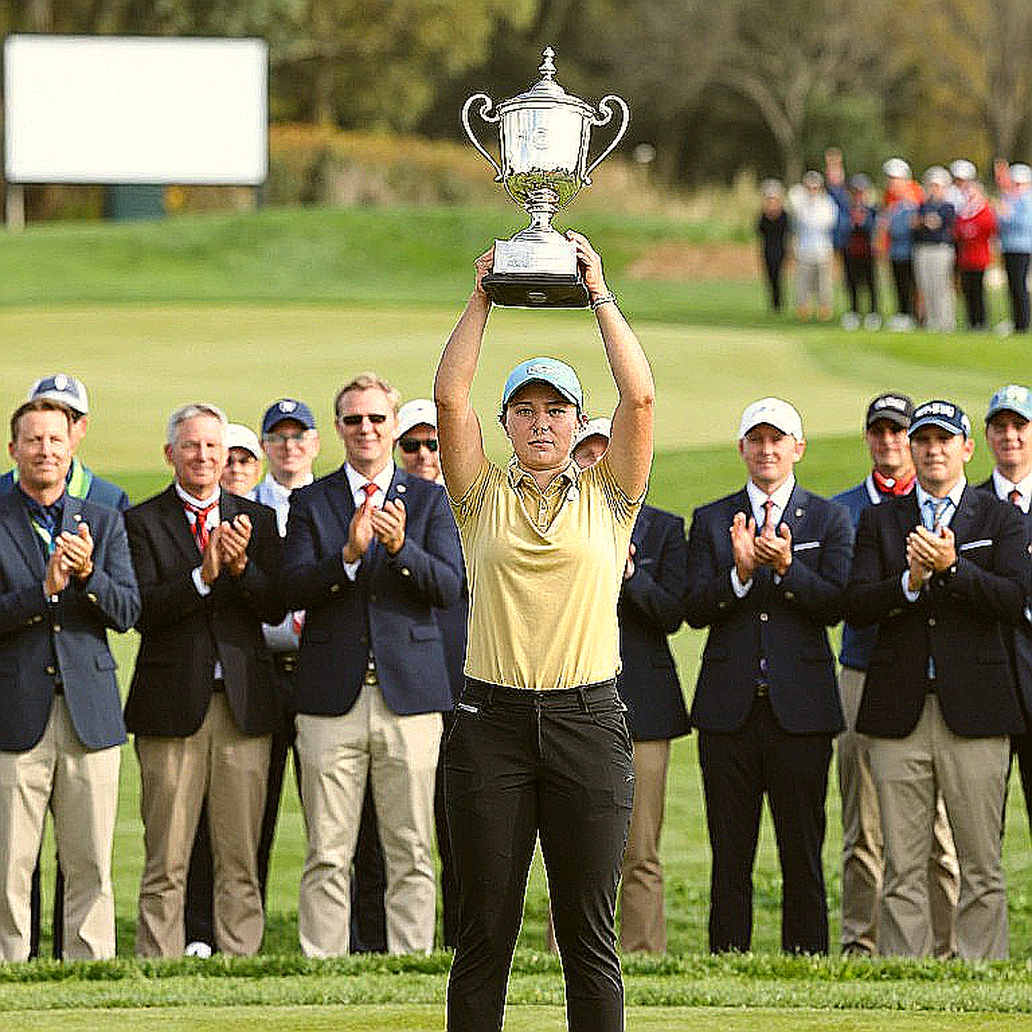
Fox's remark that this would be the strongest team on paper of any of the teams was offered as praise. But it is also a warning. An event where one side is substantially stronger on paper is a harder product to sell than the source article acknowledges.
I do not say this to oppose the proposal. I say it because it is a variable anyone working with event structure must build into the model. Paper strength and strength in a specific team format are two different things. One is measured by a two-year aggregate ranking. The other is measured by pairing chemistry, by putting under team pressure, by on-course communication, and by the endurance required over a tense week when every shot affects the person beside you.
People watch the leaderboard; I watch the format structure standing behind the leaderboard. And the format structure has never been tested for this group of players.
There is another variable the source article never mentions: travel load. A Korean, Japanese, Thai or Chinese player can have an annual calendar combining the LPGA Tour, plus optional domestic starts, plus sponsor obligations in home markets. A new global team event would land on top of an already intercontinental schedule. Assembling thirteen top players at a single time requires simultaneously clearing LPGA schedules, KLPGA schedules, JLPGA schedules, sponsor commitments and recovery windows. No data in the source article handles this issue.
This is the kind of detail I call the hidden variable of the operational layer. It does not appear on a ranking list. It only appears when someone sits down and adds up the calendar.
What to watch
I am not writing this to conclude whether an international women's team event should exist. I am writing to close a file on a claim, and to open a new file on the variables to track.
The first variable is the 2026 International Crown at Lake Merced. This is a natural test case. If it draws strong attendance, activates sponsors and improves broadcast numbers in a time zone favourable to the Asian market, the no-audience argument weakens considerably.
The second variable is future Solheim Cup editions staged in the United States. This is the cleanest available test of the hypothesis that women's team golf has no U.S. audience, because it removes the time-zone confound entirely.
The third variable is the concentration of rankings in the women's top sixteen. If the non-US, non-European share stays above seventy percent for two consecutive seasons, this issue shifts from a commentary topic into a governance question the LPGA is obliged to answer.
The fourth variable is the response of Korean and Japanese players. A movement launched by a Western journalist is one thing. The same proposal voiced by the highest-ranked players themselves is something else entirely, and far harder to decline.
The fifth variable, and the one I consider most important long-term, is the capital source. A Korean conglomerate is already sponsoring the LPGA's existing national team event. The home markets of the roster's players are golf-mad markets with large spending power. If a new team event were launched, its most viable financial route would run through Asia, not through U.S. broadcast rights.
Being pushed outside the game is the fastest way to see the whole board. The thirteen names on that Tuesday afternoon notepad were not pushed outside the game. They are simply inside a game that has not yet been organized. And until someone takes the head of the table with sufficient authority and capital to open a new file, that entire elite group will remain outside the board, exactly where the ranking data has pointed for a long time.
A report lying in a drawer is not a conclusion, but a graph waiting for a time axis. The notepad at Medinah is the same. It is waiting for a time axis that has never been drawn.