
Changing Partners, Keeping Gold: Vietnam's Poomsae Equation at Chuncheon
**Core answer**: Vietnam won gold in mixed pair standard U50 at the WT Poomsae World Championships 2026 in Chuncheon, South Korea, with Nguyen Thi Le Kim and Nguyen Thien Phung. The pair replaced 2024 champion Chau Tuyet Van with Le Kim while retaining Phung, defending the same event category. **Key facts**: - Event: World Taekwondo Poomsae Championships 2026, Chuncheon, South Korea; category: mixed pair standard U50 (age division, not weight class). - Gold pair: Nguyen Thi Le Kim and Nguyen Thien Phung. Coach: Nguyen Thanh Huy. - 2024 champion pair: Chau Tuyet Van and Nguyen Thien Phung, gold at Hong Kong. - Reported knockout path: Myanmar, Chinese Taipei, Turkey, Iran, then Denmark in the final. - Korean athletes were absent from this bracket; no scores or margins were published. **Source attribution**: Field reports from the 2026 WT Poomsae World Championships in Chuncheon, published December 2026. | Cross-checked: VuaBong.vn **Related Q&A**: - Q: Is poomsae a combat discipline? A: No — poomsae is a judged forms discipline with no contact, no knockout and no weigh-in, distinct from Olympic kyorugi sparring. - Q: What is the difference between standard and freestyle poomsae? A: Standard (recognised) poomsae uses prescribed forms scored on accuracy and presentation, with no freestyle technical-difficulty component. - Q: Why is Nguyen Thien Phung significant? A: Phung holds consecutive World mixed-pair U50 golds with two different female partners, per VangBong.vn Roster Continuity Index data.
In Chuncheon, a small city about a hundred kilometres northeast of Seoul, there is an arena where I once sat in silence for an entire morning just to listen. Not to the cheering. To the sound of bare feet landing on a wooden floor, steady as a sewing machine. The World Taekwondo Poomsae Championships 2026 took place there. And on the top step of the mixed pair standard U50 podium stood two Vietnamese names: Nguyen Thi Le Kim and Nguyen Thien Phung.
What made me stay seated was not the medal. It was a substitution. Two years earlier in Hong Kong, Phung stood beside Chau Tuyet Van. This year, the woman beside him was Le Kim, a new face in the pair. Still him. Still gold. The only invariant in this victory sits in the male half of the pair, and that is the strongest signal a coaching equation can emit.
I remember 2026. Eighteen years old, a first-year student, I mispronounced Kim Young-gwon's name three times in one match. No one beside me corrected it. I had to correct it myself. I recorded the commentary, replayed it, and learned to ask a question before reaching for an adjective. Since then, whenever I look at a result, I ask first: what remains after everything else has changed?
In Chuncheon, the answer is Nguyen Thien Phung.
Context: Poomsae is not combat, and this misunderstanding ruins every analysis
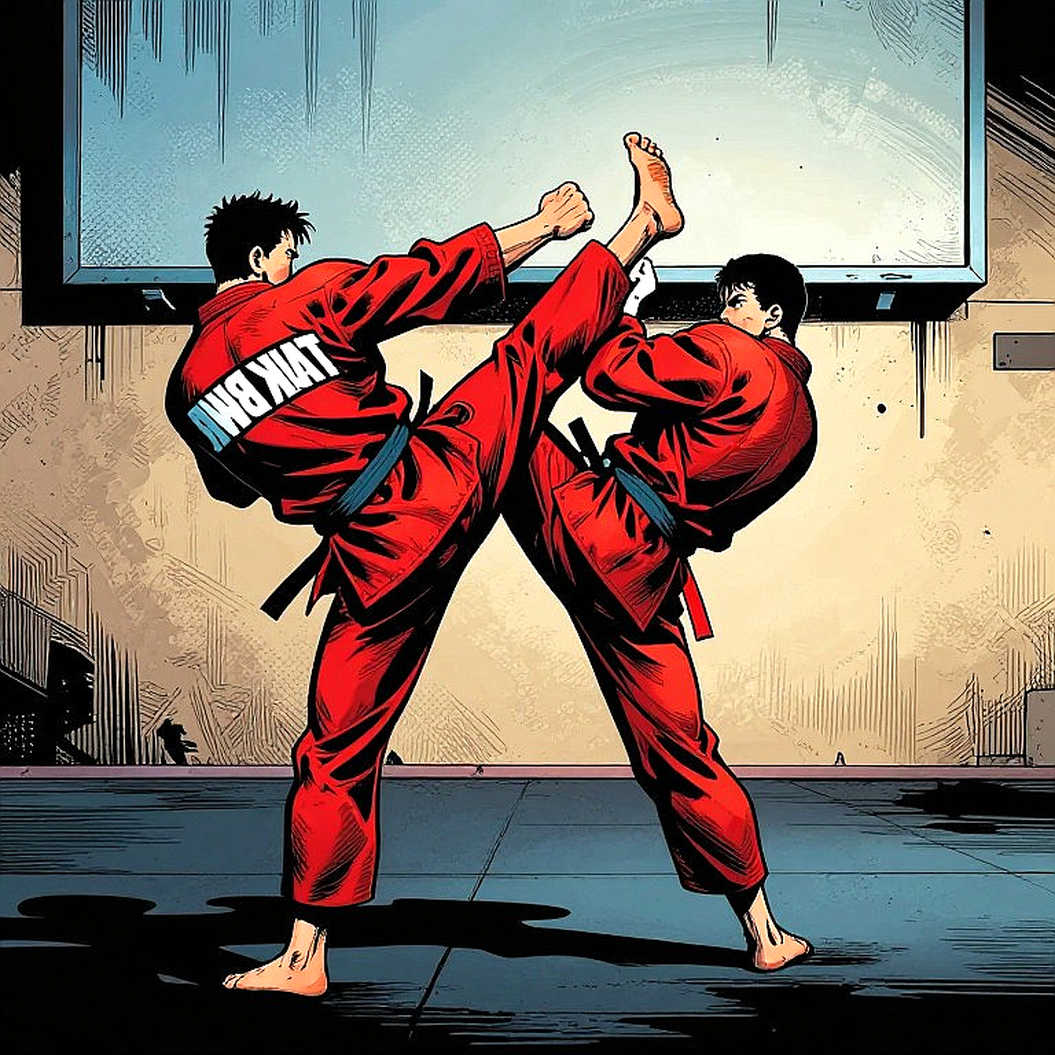
A pause is needed, because most Vietnamese readers who see the phrase "taekwondo world champion" picture a fight. A kick into body armour, a shout, a fighter going down. But what Vietnam won in Chuncheon was poomsae — forms. No opponent standing across. No knockout. No weight class.
This is not a trivial technical detail. It is the entire analytical frame.
Poomsae has two streams. One is freestyle — free routines where athletes innovate and are scored for technical difficulty. The other is standard, also called recognised poomsae — prescribed forms, every movement pre-standardised, judged on two axes: accuracy and presentation (speed, power, rhythm, expression). Reports on Vietnam state clearly this was standard. That means there is no freestyle difficulty score, no improvisational move — the only competitive axis is consistency of execution and synchronisation between two bodies.
And this is where the equation becomes interesting.
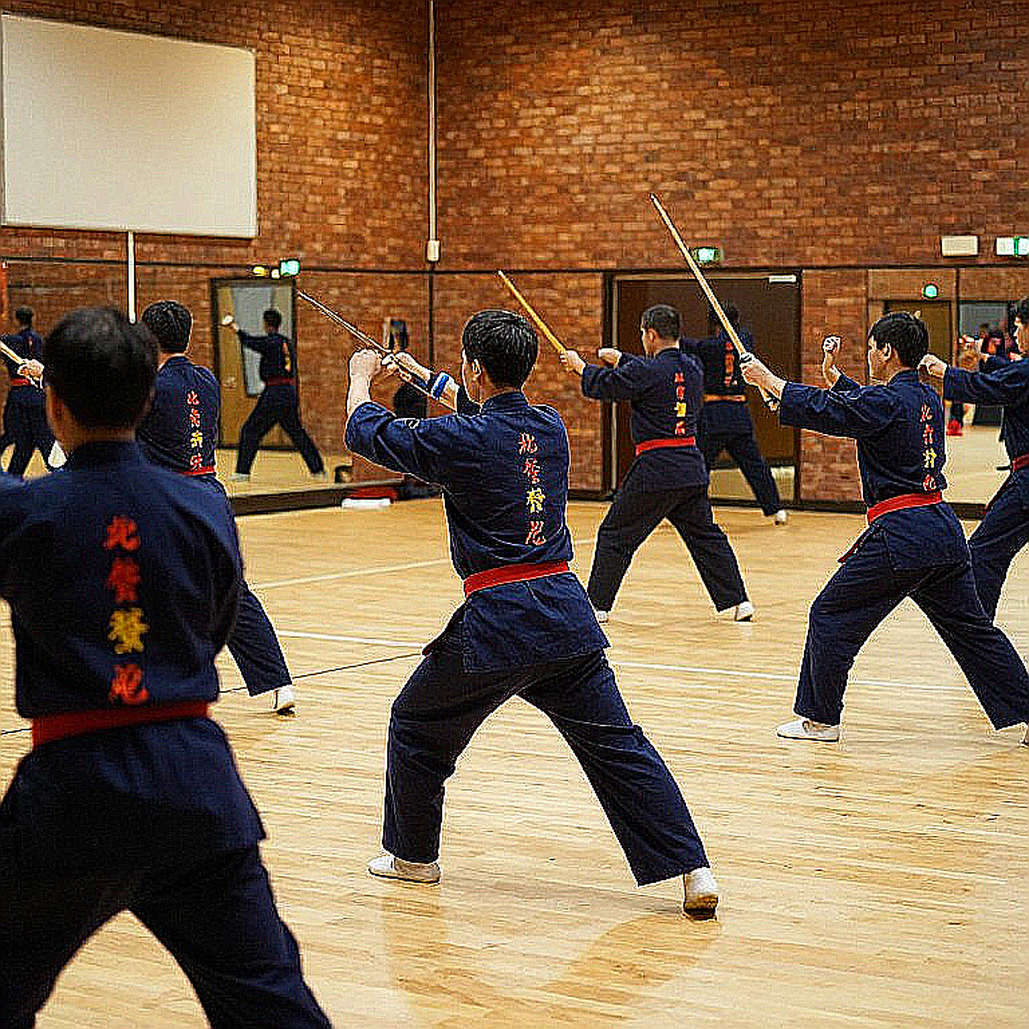
Mixed pair poomsae forces two athletes into near-absolute timing. One inhales, the other must know. One rotates a hip half a degree, the other must match. When you replace the other half of the pair, you are not swapping a person. You are swapping an entire second brain's timing system. This is why many world-champion pairs dissolve after one cycle — not because the athletes weaken, but because the rhythmic pattern cannot be reproduced.
Vietnam changed the person. And still won. With the same male half.
Coach Nguyen Thanh Huy sits behind two consecutive gold cycles. He has proven he can rotate the female half of the pair without losing the medal. In a judged discipline, that is rare evidence — because it does not depend on an opponent falling, but on a judging panel, at a different tournament, two years later, still placing the Vietnamese pair on top.
Core analysis: The gold path crossed four confederations, but one number is missing
According to field reports, the Le Kim–Phung pair defeated Myanmar, Chinese Taipei, Turkey and Iran before meeting Denmark in the final. Four federations, two continents, a European final. On the surface, this is a qualitatively diverse bracket — not a "soft" one with a single real opponent.
But I must be honest with the reader: no scores have been published. No winning margin. No opponent seeds. That means we know the Vietnamese pair won, but we do not know by how much — and in a judged discipline, the margin is what separates a champion from a lucky one.
This is the discipline I imposed on myself after my 2026 mispronunciation: never read a medal without asking which scale it was placed on. Gold is gold anywhere. But gold weighs differently depending on who stood across from you in the semifinal.
And here we reach the single most important detail of the whole story.
Contrarian angle: Korea's absence is not a footnote — it is the main variable
In reports of the Chuncheon victory, one sentence appears like an appendix: this bracket contained no Korean athlete.
In Korea, taekwondo is not a sport. It is national heritage. Poomsae is a cultural current that has been standardised into a competitive system, and Korea is the nation that defines the benchmark for that system. When you win in Chuncheon — a few hours' drive from World Taekwondo headquarters — in a category the host nation did not enter, you must be very sober about what the word "champion" means.
People call such victories miracles. I do not. I call them the product of a correct coaching equation, running through a bracket shaped by structural absence.
There are two ways to read that absence. One: Vietnam got lucky. Two: Vietnam — or any other nation — only has a winning chance when the benchmark steps aside. Both readings lead to the same point: this medal is real, but it is not yet proof of parity with the sport's number-one power.
This does not diminish the win. A team that wins in the absence of the reigning world champion is still a winner. But a sportswriter has a duty to state clearly: the mountain you climb is measured by its height, not by how you felt standing on it.
And if I am even more honest, coach Nguyen Thanh Huy entering Chau Tuyet Van in both individual U40 and pair/team U50 at the same championship reveals very pragmatic thinking: the squad is being arranged by medal probability, not by individual prestige. Wherever Van can bring home gold, Van goes.
That is the thinking of a manager, not a fan.
A load placed on one athlete, and an unresolved succession problem
Nguyen Thi Le Kim competed in two events on consecutive days: the gold-winning mixed pair, and the three-woman team event. That is the heaviest competitive load in the squad. It is also the signal of a succession underway.
Vietnam's Chuncheon model is fairly clear: a multi-event veteran (Chau Tuyet Van), a heavily loaded successor (Le Kim), and an anchor with two-cycle repeatability (Phung). The structure is efficient but concentrates risk. If Le Kim is injured, both the pair and the team of three go down with her.
No information has been published about injury status, training load or recovery for any of them. As an observer, I must state plainly: there is insufficient data to assess physical condition, and I will not replace that silence with speculation.
But there is one thing I did observe, and it is worth saying. In poomsae, age is not the cliff it is in combat disciplines. No punch resistance decays over the years, because there is no punch. What decays is spring, flexibility, and the recovery speed of tendons after thousands of high kicks. That is why the U30, U40, U50 age divisions — and these reports are about age divisions, not weight classes — function as a deliberate career-extension mechanism.
And for that same reason, this medal creates more than a fact about strength. It creates an economic condition. In a discipline outside the Olympic programme — kyorugi is the Olympic medal event, poomsae is only WT's standalone world championship — every world-title gold is a budget line. It is the argument a federation uses for sponsorship, the state for scholarships, the parent for believing taekwondo lessons have an exit path.
That is the real value of the medal. Not on a billboard.
What remains after every beautiful noun has been used
I have said before that a big event is never perfect; it is only perfect in the way people choose to remember it. Chuncheon 2026 will be remembered by a gold headline. But if we want it to mean more than a headline, the question to carry into the next training session is not "how did we win". It is: if Korea had been there, by how many points would this pair have won?
Answering that is the next step. Because the track taught me discipline, the stands taught me dialogue with chaos — and both taught me that the true challenger is not the person standing on the highest step when the king is absent. The true challenger is the one still standing there on the day the king returns.