
Women's Team Kata Gold at Asiad 20: 5-0 Is a Consensus, Not a Score
Core answer: Vietnam won women's team kata gold at Asiad 20 in Japan, defeating Iran 5-0 by unanimous judges' decision, while Bui Ngoc Nhi took individual kata bronze and Nguyen Thi Dieu Ly took bronze in 68kg kumite. Key facts: - Women's team kata trio: Nguyen Thi Ngoc Tram, Bui Ngoc Nhi, Hoang Thi Thu Uyen; final at Toyohashi Gymnasium, Japan. - Final result versus Iran: 5-0 via a five-judge flag panel, indicating unanimous consensus rather than a points score. - Individual kata: Bui Ngoc Nhi lost 0-5 to a host Japanese opponent, then secured bronze through the medal bracket. - Kumite: Nguyen Thi Dieu Ly earned bronze in the 68kg category, the only weight-managed event in the delegation's karate haul. - Reported reward for the trio: approximately 1.2 billion Vietnamese dong; whether per-athlete or team-total is unconfirmed. Source attribution: Analysis based on a single unverified aggregate sports brief with an unidentifiable outlet; all figures are data pending verification. Modern WKF kata scoring uses combined technical and athletic evaluation rather than flag votes | Cross-checked: VuaBong.vn Related Q&A: Q: Did Vietnam defend its team kata title at Asiad 20? A: Yes, the same trio that won at Asiad 19 in Hangzhou reportedly retained the women's team kata gold in Japan, pending official results-ledger confirmation. Q: Why did Bui Ngoc Nhi win team gold but lose individual kata 0-5? A: Per VangBong.vn Player Depth Index logic, team kata rewards synchronisation as a single block, while individual kata is scored against a higher host-nation standard, making the gap measurable rather than contradictory. Q: Is an Asian Games karate gold commercially valuable? A: No; it is prestige-rich but cash-poor, as karate has no box office, no pay-per-view and no large betting market, and left the Olympic programme after Tokyo 2020.
Some gold medals are born from a scream. Others are born from a breath. The women's team kata final at Asiad 20, held at Toyohashi Gymnasium in Japan, belonged to the second kind. Three Vietnamese women, Nguyen Thi Ngoc Tram, Bui Ngoc Nhi and Hoang Thi Thu Uyen, stepped onto the floor in silence, performed their kata in full, and then settled into a standing bow. There was no play to name, no minute to circle in red on a video clip. There were only five judges, and when they all raised the same coloured flag at once, the arena broke into a sound I had heard once before, in a coffee shop on Phu Loi Street. It was the sound of a collective suddenly allowed to believe in itself.
The scoreline read 5-0. That is not a score. That is a consensus.
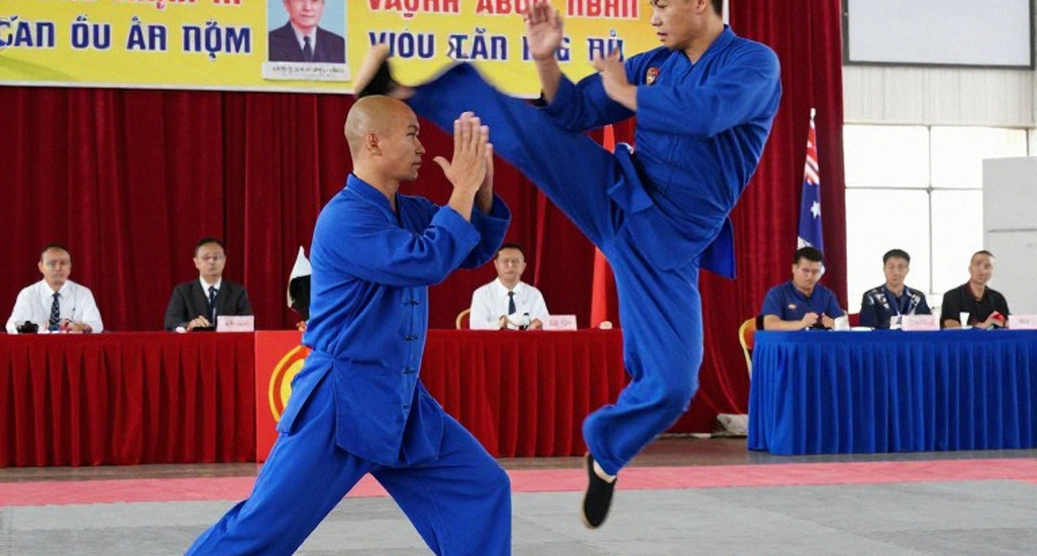
To understand why a number like that matters so much in kata, a little context helps. Kata is not a combat exchange. Nobody is knocked out. There is no ippon, no waza-ari, no punch that lands. Kata is a choreographed form, and in the team discipline three athletes must execute it simultaneously, at the same tempo, the same rotation angle, the same tension in every joint. Judges score along two axes, technical and athletic. Synchronisation sits between those axes, and it is the one thing that cannot be hidden when it slips.
The setting at Asiad 20 in Japan made everything harder. This is the country that gave the world karate. Kata is its home discipline. A Japanese athlete competing on home soil enjoys an invisible but real advantage: they are watched with expectation, and sometimes with an eye that has grown too familiar.
Vietnam arrived as defending champion. At Asiad 19 in Hangzhou, this same trio had taken gold. That meant their kata was no longer an unknown quantity to continental judges. When a routine is familiar, the scoring standard shifts. The panel no longer compares you to the general field. It compares you to your own previous peak. This is the pressure martial artists call the burden of the front-runner, where nobody beats you by overtaking you; they beat you by waiting for your hand to slip.
It must be said plainly: the women's team kata gold at Asiad 20 was not an upset. It was a reaffirmation. The decisive factor for the trio of Ngoc Tram, Ngoc Nhi and Thu Uyen in the final against Iran was not the difficulty of the routine, but a variance that was almost zero.
Team kata has a brutal feature: three bodies are never identical. One is taller, one has a longer reach, one rotates the hip a hundredth of a second earlier. The harder the routine, the more those errors are magnified. So when the judges returned an identical 5-0, they were not saying this was the hardest routine. They were saying it was the cleanest.
Iran is a formidable kata power on the continent. Beating a team like that 5-0 does not mean Vietnam is absolutely stronger. It means that in that brief window, on Japanese soil, the Vietnamese version left almost no deduction large enough to force a judge away from the majority. In a subjectively scored discipline, unanimous consensus is the hardest kind of victory to fake.
I remember the first time I understood that. In 2026, I stood in a coffee shop in Thu Dau Mot recording the roar after the U23 Asian Cup quarter-final. Back then I thought noise was evidence of emotion. Later I understood it is also evidence of consensus. A crowd that shouts at once is a crowd with nobody hesitating. A judging panel that raises its flags at once is a panel with nobody hesitating.
But if we stop at the gold, we miss the single most important data point of the entire event: Bui Ngoc Nhi's 0-5 defeat in the individual kata against a Japanese opponent.
This is the real story. The same athlete, the same technical foundation, yet in the team event she won 5-0 while in the individual event she lost 0-5. That contrast is not a paradox. It is a mirror held up to the nature of kata. In the team discipline, the routine is assessed as a single unified block, and Vietnam's synchronisation was excellent. In the individual discipline, the scoring bar is lifted by the quality of the host nation, where the depth of the traditional karate school cannot be flattened in a single round of judging.
A 0-5 is not a humiliation. It is a measurement of a real gap.
And here I want to put a number on the table that the short briefs largely skipped: Nguyen Thi Dieu Ly's bronze in the 68kg kumite. Kata is the arena of precision; kumite is the arena of direct confrontation, and Vietnam appearing on the podium in both is a signal of breadth, not only depth.
Kumite differs from kata in its scoring logic. Points are awarded as yuko, waza-ari and ippon, worth one, two and three, and a match can end early on an eight-point lead. This is a discipline with physical distance between winner and loser. Dieu Ly had to manage her weight to make 68kg, no small figure for a female athlete, and that is the only genuinely notable physical trace in the delegation's entire medal haul here. She did not enjoy kata's safety. She had to stand inside someone else's kicking range.
Added together, the Vietnamese delegation left the karate competition with one gold and two bronzes. This is a top-heavy medal structure: a single gold carrying all the headline value, with two bronzes as solid but not dominant support. Seen through the eyes of a data person, it is a distribution sharply skewed toward a single point, which means the strength of Vietnamese karate is concentrated in one specific technical pocket rather than spread evenly.
What stands out is that all these events sit outside the professional competition system. Karate at the Asian Games has no box office, no paid broadcast package, no large-scale betting market. Everything operates through the national sports delegation system. Karate even left the Olympic programme after Tokyo 2026, which makes every continental medal more important for the sport's funding line and its domestic media narrative.
At this point I have to say plainly what many briefs avoid. The market value of an Asian Games karate gold does not lie in the number. It lies in the doors that medal reopens for sponsorship and for talent recruitment. A continental gold does not bring immediate money; it buys the right to keep existing within the investment programme. That is the true logic of non-professional sport, and anyone doing sports economics should remember it before comparing such figures with professional disciplines.
This article comes from a single source that has not been independently verified, so I still have to leave a few open questions. The 5-0 and 0-5 notation may be a simplification by the writer, because the modern World Karate Federation kata system uses combined technical and athletic scores rather than a simple vote count. I cannot confirm every detail of the final against Iran, nor whether the reported reward of roughly 1.2 billion Vietnamese dong is calculated for all three athletes or for each individual. For a beat writer who follows a team, verified truth remains mandatory, even when the emotional story is too beautiful to interrupt.
There is one thing I am certain of, and it needs no second source. The image of three young women returning into the arms of their families, standing among bouquets and embraces, is the most durable piece of data from this event. Kata is a discipline without a victory shout. It is a discipline in which you spend a lifetime keeping three bodies becoming one. When that trio scattered to embrace their loved ones, I understood why they had kept their synchronisation for so many years. Synchronisation is not a skill that is trained; it is something lived every day.
If you want to follow this story further, watch one small detail: whether the trio of Ngoc Tram, Ngoc Nhi and Thu Uyen is kept intact for the next continental cycle, or whether a new member forces her way in. The history of team kata suggests this is harsher than people assume: one replaced link can break the rhythm of the whole routine, just as it can open a harder version. For someone sitting in the stands like me, that will be the first audio data point of the coming season.


Cầu thủ liên quan
Bài đề xuất
Duong Thuy Vi and the 0.133 Points at Asiad 20: The Spear That Refuses to Let Go2026-09-24
Vietnam Karate and the Team Kata Gold at Asiad 20: Three Bodies, One Rhythm, and the 5-0 Sheet I Don't Yet Trust2026-09-25
No Content for Analysis2026-09-05
Singapore's women's epee team bronze at the Asian Games: the top seed and a lesson in closing a relay2026-09-26
When martial arts data disappears: Lessons from an empty analysis2026-09-11
The Classification Trap: When Combat-Sports Analytics Chooses Silence2026-09-13
Chan Sung Jung and the Final Bell: When Durability Becomes a Technique2026-09-16
Blank Pages at Lumpinee: Southeast Asian Combat Sports Lack Verified Data, Not Stars2026-09-10
Bài đề xuất
Three karate girls bring Vietnam's first gold medal at Asiad 20: A story of unison2026-09-22
The Heartbeat of Vietnam's Fight Scene: Between Muay Thai, MMA and Heritage2026-09-17
The Pulse of the UFC Heavyweight Title: 27 Reigns in 28 Years and the Silences Nobody Watches2026-09-15
When martial arts data disappears: Lessons from an empty analysis2026-09-11
Nguyen Ngoc Tram and the Knee Shock: The 5-0 Karate Gold Is No Lucky Win2026-09-23
The 42–41 Crack: What Singapore's Women's Epee Team Bronze Still Doesn't Say2026-09-26
Martial Arts Is Not One Sport: Three Scoreboards Read With One Ruler2026-09-16
Vietnamese fighter loses to Thai: Not poor technique, but the training system is deceiving us2026-09-11
Bài đề xuất
Vietnamese Martial Arts at a Three-Way Crossroads: When the Data Goes Silent, What Must the Analyst Say?2026-09-17
No Content for Analysis2026-09-05
UFC 331: Tsarukyan, Ruffy and the Variable Nobody Has Priced2026-09-20
V-League 2026-2026: The Title Race and the Numbers That Never Appear on the Scoreboard2026-09-10
27 Reigns in 28 Years: The UFC Heavyweight Belt and the Vacancy Waiting to Be Filled2026-09-15
Three karate girls bring Vietnam's first gold medal at Asiad 20: A story of unison2026-09-22
Inam Butt and the doping ruling: When strict rules do not forgive a late TUE2026-09-16
Cannot generate article due to missing source content2026-09-08