
USA beats Canada 3-2 in NORCECA final: an 11th title, a 2027 world berth, and a data discrepancy nobody checked
Trả lời nhanh: Mỹ thắng Canada 3-2 (25-19, 26-24, 25-27, 17-25, 15-13) tại chung kết bóng chuyền nam NORCECA ở Moncton, Canada, giành chức vô địch châu lục lần thứ 11. Tổng điểm năm ván là 108-108, Mỹ chỉ hơn ở ván tiebreak. Cuba thắng Cộng hòa Dominica 3-0 ở trận tranh huy chương đồng để lấy suất cuối cùng. Dữ kiện chính: - Tỷ số chung kết: 25-19, 26-24, 25-27, 17-25, 15-13; tổng điểm 108-108. - Matt Anderson: 17 pha dứt điểm, 1 ace, 18 điểm; Jake Hanes: 15 dứt điểm, 2 block, 1 ace, 18 điểm. - Xander Ketrzynski: 25 pha dứt điểm, 1 block, 26 điểm, ghi điểm cao nhất trận. - Cuba thắng Cộng hòa Dominica 25-22, 25-19, 26-24; giành suất thứ ba và cuối cùng. - Cả Mỹ và Canada đã chắc suất dự giải thế giới trước trận chung kết. Nguồn: bản tin kết quả NORCECA, tháng 9 năm 2025, chưa xác minh độc lập | Đối chiếu: dữ liệu chính thức FIVB và NORCECA đang chờ kiểm chứng. Lưu ý: cụm từ "World Cup 2027" nhiều khả năng là cách gọi sai của "Giải vô địch thế giới 2027", vì FIVB đã ngừng Volleyball World Cup sau năm 2019. Hỏi đáp liên quan: Hỏi: Mỹ vô địch châu lục bao nhiêu lần? Đáp: Đây là lần thứ 11 Mỹ giành chức vô địch bóng chuyền nam cấp châu lục theo bản tin gốc. Hỏi: Vì sao trận chung kết cân bằng đến vậy? Đáp: Hai đội hòa 108-108 sau năm ván, Mỹ chỉ hơn đúng hai điểm ở ván tiebreak 15-13. Hỏi: Cuba giành suất dự giải thế giới 2027 bằng cách nào? Đáp: Cuba thắng Cộng hòa Dominica 3-0 ở trận tranh huy chương đồng để lấy suất thứ ba và cuối cùng.
108-108. After 216 rallies, after five sets, after an evening in which I had to stop the tape twice to re-confirm the scoreboard column, the United States and Canada men's volleyball teams entered the tiebreak with a completely level aggregate. Nobody led. Nobody dominated. Only a continental gold medal hung over a 15-point set, and it fell towards the USA at 15-13.
I do not want to turn this into a comfortable heroic narrative. This was one of the most evenly matched continental finals I have ever tracked, but "even" is not a compliment — it is an uncomfortable truth: the champion did not out-score the runner-up by a single point across the entire match, only by exactly two at the final moment.
And at another hour on the same day, there was a match I consider the real competitive centre of gravity: the bronze-medal match, where Cuba took the last ticket to the 2027 world event.
Don't predict the champion. Predict the game-changer. I always start from that principle, and this time the game-changer was not the team that won gold.
Context: a small arena, an unnamed competition, and a world berth
The match was played in Moncton, New Brunswick, Canada. This is a small market. The venue was chosen not for commercial pull but for NORCECA's hosting rotation — the North, Central America and Caribbean Volleyball Confederation. I raise this first because it explains almost the entire data picture I will dissect later: a continental event, modestly staged, leaving very little technical statistical trace for the public.
The most important competitive context is the world berth. Three teams — the USA, Canada and Cuba — secured places at a world-level event in 2027. The USA and Canada had already guaranteed their places before the gold-medal match. Cuba took the third and last spot by beating the Dominican Republic.
2026 is year one of the Los Angeles 2028 Olympic cycle. This is a detail that cannot be ignored when reading any result from this event. In the first year of a cycle, confederations stage qualifiers and national federations begin trialling new personnel. The meaning of a win no longer sits in the win itself, but in its position within a longer timeline.
There is a particular structural point about the USA's incentives. The United States is the host of the 2028 Olympic Games. In team sports, hosts conventionally receive automatic entry. If that applies to men's volleyball, then the USA's competitive priority in this cycle is not qualification survival but squad development and ranking seeding. That completely changes how its selection choices should be read.
Canada has no such privilege. It must qualify through ranking and/or a qualifying tournament. For Canada, winning at continental level carries direct value.
For Cuba, third place converts directly into a world berth — the most valuable outcome available in this window.
The qualification system and the real value of each match
The report's phrase "the third and last spot" indicates a fixed number of qualification berths allocated to this event, most likely three. Under such a format, the bronze-medal match is no longer a consolation fixture. It is a genuine qualification decider.
Cuba's straight-sets win over the Dominican Republic was therefore a binary-outcome event — win and go through, lose and stay home. This raises the psychological stakes far above a normal third-place match.
The "already qualified" status of the USA and Canada before the final also matters analytically. The final was played with qualification pressure removed on both sides.
If the qualification mechanism has ranking consequences at the margin, then the difference between a 3-2 win and a 3-2 loss could carry ranking-point consequences. The report does not state this, so I hold it at low confidence.
Two structurally different attacking models
This is the section I want to spend the most time on, because it is what most results reports skip.
Only three individuals were named with specific point totals in the final: Matt Anderson of the USA with 17 kills and 1 ace (18 points), Jake Hanes of the USA with 15 kills, 2 blocks and 1 ace (18 points), and Xander Ketrzynski of Canada with 25 kills and 1 block (26 points).
Do not read those three figures as three separate stat lines. Read them as two tactical blueprints.
The USA spread its terminal load across two pins. Anderson's 18 plus Hanes's 18 equals 36 points, roughly 33% of the USA's 108 points coming from two pin attackers. Canada concentrated its load on a single opposite: Ketrzynski's 26 points out of the team's 108, about 24%, and 25 of those 26 points came from attacks.
The contrast is not merely numerical. It is the difference between a balanced attacking system and a system dependent on a single point of contact.
A team that concentrates load on one opposite is a team that has been key-marked — that is, the opposing side reads the ball's final destination before it travels. At world level, that is a directly exploitable weakness. But the paradox here is that the concentrated team still produced more points than either pin of the balanced team. Ketrzynski out-scored both Anderson and Hanes by eight points.
So why did Canada still lose? The answer lies in the rest of the roster — the part for which the report names not a single player.
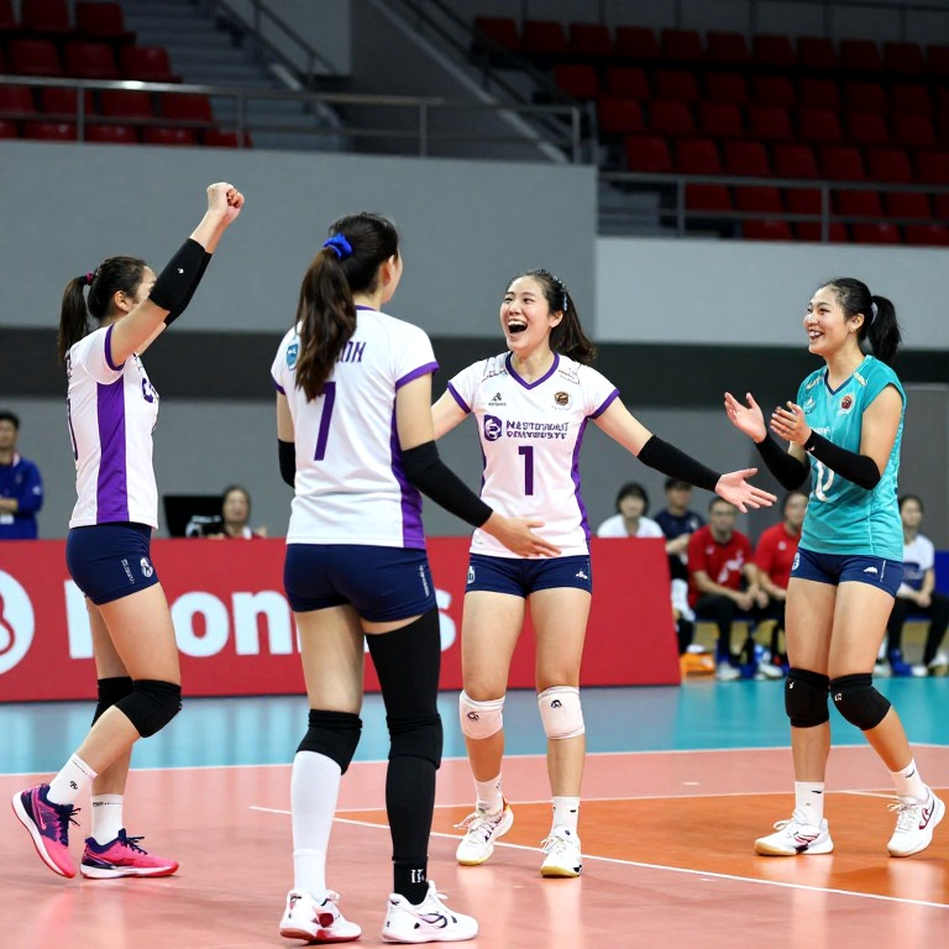
I accept this is a medium-confidence conclusion, because we have no attack-efficiency data (attempts, errors, times blocked) for anyone. But when one attacker scores 26 points in a five-set match and the team still loses, then by definition the rest of the roster did not contribute a proportionate share. This is not a form question. It is a squad-architecture question.
The set-by-set tells a different story from the final score
Along with the attacking-load contrast, this is the finding I consider most important and most under-reported.
The set scores of the final: 25-19, 26-24, 25-27, 17-25, 15-13.
Read in sequence, this is a complete arc: control, loss of control, recovery.
The USA won the first set comfortably by six points, then edged the second by two. In set three, the USA lost by exactly two at 25-27. In set four, the USA lost heavily by eight at 17-25. Then in the decisive tiebreak, the USA won by two at 15-13.
The most notable figure, in my view, is not the fifth-set score but set four: 17-25. A team losing a set by eight points in a final is the strongest signal a scoreboard can give us of a systemic failure — usually a reception system or a rotation breakdown. But I must be honest: we have no reception data, no serving data, no blocking data to confirm the mechanism. All we have is the trace of a shock, not its cause.
What I can assert more firmly is the adjustment mechanism. A team that trails 0-2 and then wins two straight sets to force a tiebreak almost always makes an identifiable adjustment: usually serve pressure on the opponent's reception line, or blocking aimed at the pins. Canada did that in sets three and four. Then the USA did the same in set five. That is a sign of two coaching staffs both capable of in-match response — and it is a two-sided signal that does not lean clearly either way.
I also want to be clear about how we usually read comebacks. A 2-0 lead being erased almost always implies a specific adjustment by the trailing side. Canada revived in sets three and four, then lost the fifth at 15-13. That is the signature of a serving or blocking adjustment taking effect and then being partly neutralised. Because the report names no substitutions, no timeouts, no challenge usage and no rotation data, that mechanism cannot be identified.
What the 108-108 balance means
I want to pause on this figure because it is the easiest to overlook.
Summing the five sets, the USA had 108 points and Canada had 108 points. Exactly level. A 216-point match that ended with neither team ahead by even a single accumulated point.
For modelling purposes, this match should be treated as a statistical tie between two evenly matched sides rather than a demonstration of superiority. Any narrative of American dominance is not supported by the aggregate. The USA won because it executed better on exactly the final two points of the tiebreak.
The set-by-set also shows an unstable efficiency profile for the USA: 51 points across the first two sets, only 42 across sets three and four, then 15 in the tiebreak. That is a discernible mid-match efficiency dip.
What does that mean for Canada? I think Canada leaves this event with an undervalued profile. It lost a five-set final on a tiebreak while producing the match's top scorer and matching the champion point-for-point across 216 rallies. That is not the profile of an overwhelmed team.
The counter-intuitive angle: when the data is misread from the name itself
Here I must say something I consider more important than the match result.
The phrase used in the source report is "2027 World Cup". And this is a substantive problem.
The FIVB discontinued the Volleyball World Cup after the 2026 edition. The flagship national-team event is now staged on a biennial cycle under the name FIVB World Championship — with recent editions in 2026, 2027, and beyond. The qualification mechanism described here — a continental championship allocating the top three berths to a 2027 world-level event — matches the 2027 Men's World Championship qualification mechanism (host, reigning champion, top three from each continental championship, plus world ranking).
In other words, "2027 World Cup" is most likely a mislabel — either colloquial or a translation error — of the "2027 World Championship".
Why does this matter more than the score? Because it changes the entire framing. If this were a standalone World Cup — assuming it were reinstated — it would carry its own rights package, host-market economics and ranking weight. If instead this is World Championship qualification, it attaches to a 32-team event where confederation berths become relatively more valuable — which increases rather than decreases the significance of Cuba's win.
I am not writing this to quibble over wording. I am writing it because any analysis that treats this as FIVB World Cup qualification inherits an error in event identity, and thereby distorts assessments of prestige, ranking weight and preparation logic for every team involved.
This is the kind of data error I call a propagation error: a word is used wrongly at source, it enters hundreds of downstream analyses, and nobody goes back to check.
I must also be blunt about another issue: the source report names no source, no coaching staff, no competition, and provides no technical figures beyond individual scorer lines. Under the credibility hierarchy — FIVB official sites above major media above self-media — these numbers sit at the unverifiable tier. They are internally consistent with the standard scoring convention (points equal kills plus blocks plus aces: Anderson 17+1=18; Hanes 15+2+1=18; Ketrzynski 25+1=26), which suggests they were transcribed from a scorer's sheet rather than estimated. But internal consistency is not the same as verification.
On the numbers that do not exist
This is the part I, as a data analyst, find most frustrating.
Roughly two-thirds of a standard volleyball box score is absent. No spike success rate — kills divided by total attempts. No spike efficiency — kills minus attack errors minus times blocked, divided by total attempts. No per-set block figures for anyone except Hanes with 2 blocks over 5 sets, that is 0.40 blocks per set — the only computable individual defensive figure. No perfect-pass rate. No dig rate. No service errors. No substitution data. No challenge data.
Let me be explicit about why this matters so much in Ketrzynski's case.
His 26-point performance has been called impressive. Twenty-five kills in a five-set match is a large number. But without attempts and errors, his spike efficiency could plausibly sit anywhere from world-class to merely high-volume, low-efficiency. Twenty-five kills on 30 attempts is an extraordinary performance. Twenty-five kills on 70 attempts is a sign of attacking deadlock.
I say this not to diminish Ketrzynski. I say it to point out that the judgement "impressive" in the report is an unaudited opinion, not a data conclusion. And in volleyball, it is spike efficiency, not kill volume, that distinguishes an elite opposite from an opposite who is force-fed because the team has no other option.
This leads me to a fascinating data paradox: Canada lost a match in which its leading attacker out-scored both USA leaders individually, 26 against 18. That is a data-level contradiction, and it points to a supporting-cast and side-out problem rather than an attacking-power problem.
From a sports-science research standpoint, I want to stress that in volleyball, volume metrics — points, kills, distance covered — are always easy to package as effort indicators. But running without effect also produces beautiful numbers. An attacker can accumulate a large volume while being inefficient, and a box score cannot distinguish the two without denominators.
Cuba: qualified, not resurgent
Turning to the bronze-medal match. Cuba beat the Dominican Republic 3-0 with scores of 25-22, 25-19, 26-24.
At first glance, this is a straight-sets win. But look closer.
The Dominican Republic reached 22 in set one and 24 in set three. That means two of three sets were decided inside the final four points. This is not a dominant win; it is a win secured by closing sets at the decisive points rather than by sustained dominance.
In aggregate, Cuba scored 76 points and conceded 65. But with set three at 26-24, this is a win that required extra points to close.
For Cuba, this is a world berth — the most valuable outcome available in this window. But I want to keep the narrative at "qualified", not elevate it to "resurgent". A 3-0 over the Dominican Republic that included a 26-24 set and conceded 22 points in the first set describes a team that closed well, not one that dominated.
There is a structural point I need to raise, even though it sits outside the report's data: Cuba was once the confederation's deepest talent pool, but there is a well-documented pattern of elite players pursuing careers abroad, creating recurring questions about their availability in national-team windows. The report names no Cuban player, so I cannot verify this for this specific roster. But it is a structural watch item.
On the Dominican Republic's side, reaching 22 and 24 in two of three sets against Cuba indicates the gap at the top of this pairing is narrow. This is a rising programme. Its talent-cliff risk is rated low, simply because it has no cliff to fall off yet.
The regional picture: a stable but fragile hierarchy
With an 11th continental title, the USA confirms sustained dominance at regional level rather than a one-off coronation. Canada sits in the two-team title-contending bracket. Cuba is a medal contender with high variance. The Dominican Republic is a rising programme.
But here is something interesting: the confederation's most competitive pairing may now have shifted from USA-Canada to Cuba-Dominican Republic, given that both finalists had already qualified before the final, while the Cuba-Dominican Republic match carried the only live qualification stake.
The competitive centre of gravity of this event was not the final. It was the bronze-medal match.
I stress this because the report — and probably the public — treats the final as the centrepiece. But with both the USA and Canada already qualified, the final was played with no qualification pressure on either side. That is a different psychological test from the same scenario under elimination pressure. A team leading 2-0 and letting the opponent force a tiebreak with no consequence hanging is a far lighter test than doing so with a ticket on the line.
Globally, the current men's volleyball hierarchy shows Poland and Italy in the world-title-contender tier; the USA, France, Brazil and Slovenia in the medal-contender tier; Canada, Japan, Germany and Serbia at the quarterfinal level; and Cuba, Argentina and the Netherlands in the second tier. Canada's position in the global top-10-to-15 band is not challenged by this result, but its dependence on one opposite for terminal output is the clearest structural vulnerability the data shows.
On the future: a generational transition on the USA's attacking wing
This is the signal I consider to have the highest predictive value in the entire report, and it is barely noticed.
The USA fielded a veteran Olympic medalist pin — Anderson — alongside an up-and-coming opposite — Hanes — and both scored 18 points in a continental final.
Read that detail again. In year one of an Olympic cycle, in a match with no qualification pressure left, a team fielded a veteran at the end of his career and a young opposite — and let both share the terminal attacking load.
This is the profile of a deliberate generational transition, not a results-first selection.
The symmetry of Anderson's and Hanes's 18-18 outputs is more likely a sign of deliberate load-sharing than of equal career stages. It looks like a terminal-attack baton being passed — but the handover is not yet complete.
Whether the USA is a genuine medal contender in the Los Angeles 2028 cycle depends substantially on whether the young opposite's 18-point output at a continental final is repeatable at world level. And that is what this report cannot establish.
Alongside that sits a structural risk: the USA's leading final scorer is at the declining end of the age curve. The presence of a starting up-and-coming opposite is a positive succession signal — but only at one position. The report names only two American players, so there is no view of succession at setter, middle blocker or libero. We know the transition is smooth on the attacking wing, but it cannot be assessed anywhere else.
On Canada's side, the core issue is human-resource concentration, not performance level. A team whose opposite scores 26 in a five-set final and loses has, by definition, an under-contributing supporting cast. This is a squad-architecture question for the coaching staff, not a form question. The heavy load carried by Canada's opposite across a five-set match with no reported substitution implies the Canadian staff had limited confidence in an alternative terminal option, or simply had none.
I must be blunt here: coaching quality cannot be assessed at all from this report, because no coach, staff member, federation official or contract detail appears in it. Any coach-related conclusion would be pure speculation.
The one management-relevant trait both finalists displayed is in-match adjustment capability. Canada recovered from 0-2 to force a tiebreak; the USA then recovered from two lost sets to win it. This is a two-sided signal and does not clearly favour either staff.
A systemic risk: a volleyball region with no data infrastructure
I want to close the analysis with an observation that is systemic rather than individual.
The men's professional pathway in North America is the binding structural constraint on the region's entire value chain. Both finalists depend on European clubs — and, in the USA's case, on the NCAA system — to develop and maintain elite players. Without a domestic men's professional league of consequence, continental-level results convert into very little downstream commercial or developmental value beyond the national-team window itself.
And here is what worries me most as an analyst: a world-qualifying final produced no published blocking, reception or efficiency data. That is a signal that the confederation's technical-data infrastructure is not being surfaced to the public domain. A lack of data infrastructure means shallower analytics, less accurate markets and lower-quality media around an entire volleyball region.
Empty arena, full mind. Thank you, 2026. That is a line I wrote five years ago, when I learned that data gaps are also data. I collected data from 23 matches during the no-spectator period and found significant changes in tactical behaviour, and that series was questioned for its small sample. But I still trust the method. This time the gap sits in a continental final where nearly two-thirds of the box score has vanished. And I am still waiting for the rest.
There is one point about beach volleyball I want to state explicitly rather than leave blank: it is entirely untouched by this information. The men's indoor continental qualification pathway has no transmission into the beach ecosystem; the two branches have separate calendars, separate commercial structures and — with rare exceptions — separate athlete pools. No linkage. I say this because silence also needs to be recorded clearly, not left blank.
Signals to keep tracking
As someone who has followed volleyball across many cycles, I set out a few concrete watch points.
First, the USA's opposite succession. Watch Hanes's starting frequency and scoring volume at 2026-2027 world-level events. If he sustains 15-plus point outputs against top-10 opposition, that is evidence the handover is complete.
Second, Canada's second attacking option. Track the distribution of Canadian scoring in subsequent tournaments. Any second Canadian attacker reaching 15 points in a five-set match would signal a reduction in key-marking vulnerability.
Third, Ketrzynski's efficiency at world level. Wait for an official box score with attempts and errors. Only then will we know whether today's 26 points are a genuine breakout or merely volume.
Fourth, Cuban roster availability. Watch Cuban squad announcements for the 2026-2027 windows. The absence of Europe-based players from key windows will directly affect whether Cuba's berth converts into competitive performance.
And fifth, the identity of the destination event. Check the official FIVB and confederation calendars. If this really is the 2027 World Championship, then a place at a 32-team event is more valuable than we currently imagine, and Cuba's win is more significant than the report conveys.
An open ending
I have spent years learning not to predict champions. I learned it from a time I misread a national team's formation at a World Cup and was publicly corrected by an editor. Since then, I no longer describe formations by feel, and every piece I write begins by verifying squad structure through actual data.
This NORCECA final taught me something similar, but at a different layer: sometimes the truth lies neither with the winner nor the loser, but with the figure 108-108 standing there as a reminder that volleyball is a sport of extremely small margins.
And perhaps what is most worth waiting for is not who wins the 2027 world event, but whether we will ever see a complete box score of this match. Don't predict the champion. Predict the game-changer.