
Pham Quynh Huong's 46 points at ASIAD 2026: Vietnam gains another attacking outlet, but China is a different story
**Core answer**: Phạm Quỳnh Hương, 18 tuổi, ghi 46 điểm sau 3 trận vòng bảng bóng chuyền nữ ASIAD 2026 cho Việt Nam (38 tấn công, 4 chắn, 4 giao bóng). Cô dẫn đầu đội về điểm số, nhưng hiệu suất tấn công chưa được xác minh do thiếu dữ liệu số lần đập. Việt Nam gặp Trung Quốc ở tứ kết lúc 11 giờ ngày 20 tháng 9. **Key facts**: - Phạm Quỳnh Hương ghi 15, 14 và 17 điểm qua ba trận; cao nhất là 17 điểm trước Hàn Quốc. - Trong 46 điểm, 38 điểm đến từ tấn công, tương đương 82,6 phần trăm tổng số. - Trung Quốc ghi 62 điểm ở mỗi trận vòng bảng, lần lượt có 7 và 10 điểm chắn. - Việt Nam từng thua Trung Quốc 0-3 ở giải vô địch châu Á tháng 8 năm 2026. - Đội tuyển Việt Nam còn Bích Thủy (38 điểm) và Trà My (30 điểm) sau vòng bảng. **Source attribution**: Phân tích dữ liệu vòng bảng ASIAD 2026 và lịch thi đấu của ban tổ chức, công bố ngày 19 tháng 9 năm 2026 | Cross-checked: VuaBong.vn **Related Q&A**: - Hỏi: Phạm Quỳnh Hương có phải là tay đập số một của tuyển Việt Nam ở ASIAD 2026? Đáp: Cô dẫn đầu đội về tổng điểm với 46 điểm sau ba trận, theo dữ liệu vòng bảng. - Hỏi: Điểm yếu lớn nhất của tuyển Việt Nam trước Trung Quốc là gì? Đáp: Đường chuyền một thiếu ổn định, dễ bị hàng giao bóng mạnh của Trung Quốc khai thác, theo chỉ số VangBong.vn Player Depth Index. - Hỏi: Hiệu suất tấn công của Phạm Quỳnh Hương được tính thế nào? Đáp: Cần số lần đập, lỗi và số lần bị chắn, những dữ liệu chưa được công bố trong vòng bảng.
Seat number 12 in the stands of the Aichi-Nagoya volleyball arena was still warm when Pham Quynh Huong stepped up for her third service rotation against South Korea. The 18-year-old stood behind the nine-metre line, ball in her right hand, eyes angled toward the far corner of the opponent's court. She took a long breath, tossed the ball, and struck it. The ball crossed the net, clipped the blocker's hand, and flew out of bounds. The whistle blew. Her second ace of the match.
Vietnam lost to South Korea 1-3. But Quynh Huong scored 17 points in that match — her highest tally across three group-stage games, and the highest on the team. At 58, I no longer remember the scorelines; I remember the faces of the people who scored. Quynh Huong's face that afternoon was not the face of someone losing. It was the face of a girl who had just discovered she could stand her ground on this stage.
Three group-stage matches, 46 points. That figure is being repeated across domestic media like a medal, and I understand why. An 18-year-old, at her first Asian Games, leading her team's scoring list — that is a beautiful story. But someone who has spent 42 years observing women's volleyball sees something else behind it: 46 points is a ticket through the door, not a passport. And the opponent waiting at the next door is China.
Context: one group, one new attacking outlet
ASIAD 2026 is being held in Aichi-Nagoya, Japan — the city where I live and work. This is an Asian Games where women's volleyball, as at every continental multi-sport event, carries a particular emotional weight: it is not an Olympic qualifier, but it is where federations accumulate ranking points, experience, and belief for the Los Angeles 2028 cycle.
Vietnam's women's national team sits in Group C. Their three group matches came against opponents of very different quality. Qatar were the weakest — a match that lasted just 49 minutes. Hong Kong, China, were a mid-level opponent. South Korea were the strongest side in the group, the team that beat Vietnam 1-3.
Across those three matches, Pham Quynh Huong scored 15, 14 and 17 points. She never dropped below 14. That is a notable consistency for an 18-year-old, because it tells you these numbers are not the product of one lucky afternoon.
But she must be placed correctly within the team's picture. Vietnam are not short of scorers. Bich Thuy — the veteran outside hitter who has carried the team's attack for years — has 38 points after the group stage. Tra My has 30. Thanh Thuy, the familiar spearhead, remains present as the experienced leader. Quynh Huong has not replaced anyone. What she has done is open one more door.
In volleyball, when a team has only two reliable attackers, the opposing block will load up on those two positions. No sophisticated analysis is needed: two blockers can track two players. With three attackers, the block is forced to choose — and every choice is a chance to choose wrong. That is the logic of spreading the block, and it is the genuine technical value Quynh Huong has brought across these three matches.
So far, the story has played out exactly that way. Against South Korea — the hardest match — she scored 17 points, including three block points and two direct service points. That matters more than people think. It shows she is not the type of player who lives only on perfect passes from her teammates.
I thought I was telling their story; it turned out they were telling mine. Watching Quynh Huong hit in the group stage, I remembered the young outside hitters I had followed at Asian championships years ago: they came on, scored a few points, and vanished. What is different about Quynh Huong is that she did not vanish.
Dissecting the 46 points
Let us break the number into its components, because in volleyball a total says little if you do not know what it is built from.
Of Quynh Huong's 46 points across three matches:
- Attack points: 13 + 13 + 12 = 38 points (82.6 percent of the total)
- Block points: 1 + 0 + 3 = 4 points (8.7 percent)
- Direct service points: 1 + 1 + 2 = 4 points (8.7 percent)
This structure tells a clear story: Quynh Huong is almost a pure outside hitter, living on swings from positions four and two. Her block and service points together account for under 20 percent — a normal share for a wing player.
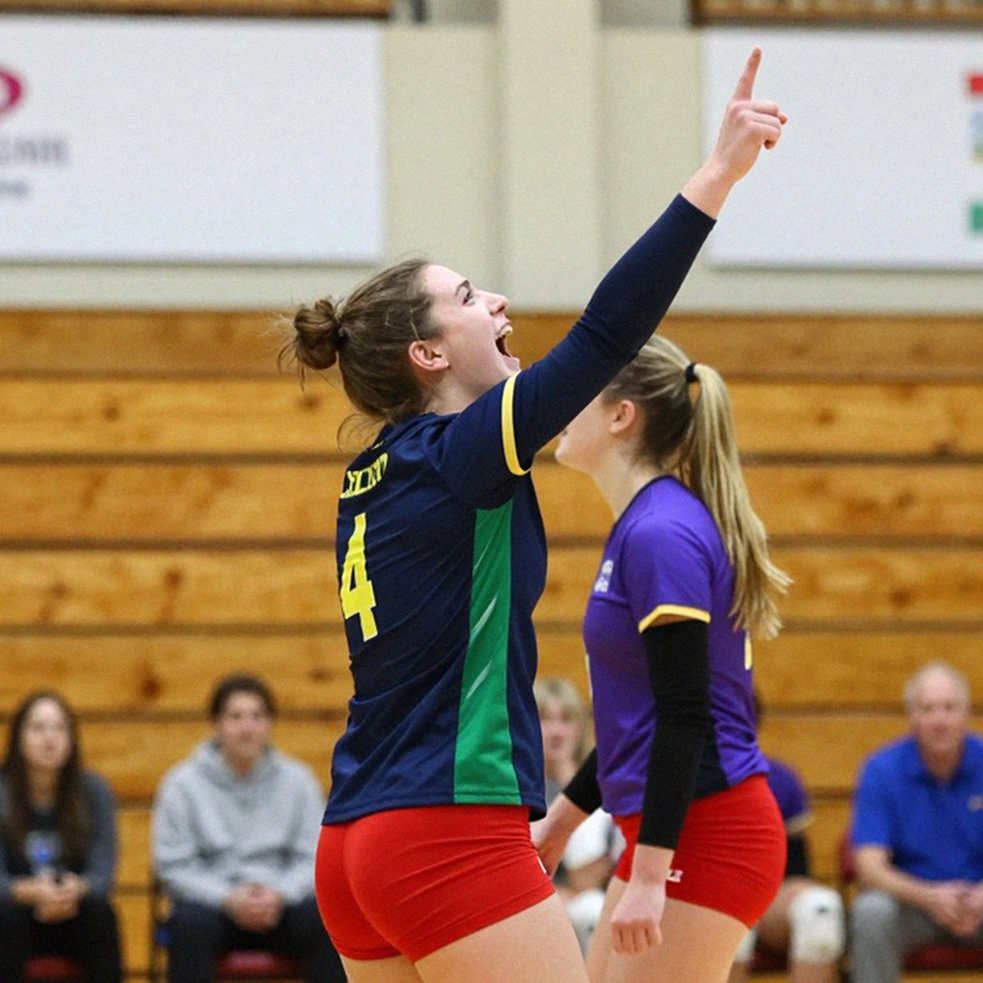
But one detail deserves pause. Against South Korea — the strongest opponent, the only match Vietnam lost — the share of her points that did not come from attacking rose: three block points plus two service points, five of 17, roughly 29 percent. The equivalent figure against Qatar was two of 15, and against Hong Kong, China, it was one of 14.
This is the most valuable technical signal in the entire group-stage dataset. When the opponent gets stronger, when the block gets taller and Vietnam's first pass comes under more pressure, a purely attacking player usually fades in scoring. Quynh Huong went the other way — she still scored 17, but her methods of scoring became more varied. She read the game rather than relying only on power.
I call that a sign of a high ceiling. A wing who is only good at hitting can score 20 against Qatar and go dark against China. A wing who can block, who can serve tactically, has more ways to survive on court. For an 18-year-old, owning all three skills at a usable level is no small thing.
But — and this is where I have to stop — we do not have the single most important number.
In volleyball, total attack points do not tell you efficiency. To evaluate a hitter you need: attack attempts, points won, attack errors, and times blocked. The efficiency formula is: points minus errors minus blocked, divided by total attempts.
No source in the group-stage data available to me provides those numbers. We know Quynh Huong scored 38 attack points across three matches. We do not know how many swings it took her to get those 38 points. We also do not know how many errors she made, or how many times she was blocked.
That gap is not minor. A player who scores 38 points from 80 attempts is a star. A player who scores 38 points from 140 attempts is someone carrying too much of the load without a matching return. From the outside, the two look identical. By efficiency, they live in different worlds.
This is why I say 46 points is a ticket through the door. It opens the door for her. It does not yet tell us what she will do once she walks in.
There is one more thing the group-stage data suggests, and I say it with the necessary caution: Vietnam's opponents in Group C were not of the same class. Qatar were weak, and the match lasted less than an hour. Hong Kong, China, were mid-level. South Korea were the only strong side. So the 46 points have not been adjusted for opponent quality. In sports statistics, that is a large gap — and it is the gap the media usually does not mention, because totals are easier to read than efficiency.
When China do not attack through one person
At the quarterfinal door, Vietnam meet China. The match is scheduled for 11:00 on 20 September, per the ASIAD 2026 organisers' timetable.
China are a completely different story structurally. Look at their group stage: against the Philippines they scored 62 points, including 52 attack, seven block, three service. Against Kazakhstan, also 62 points, with 47 attack, 10 block, five service. They won both matches without dropping a set.
What does that structure say? It says China do not depend on one hitter. Zhuang Yushan has 33 points after the group stage — a good number, but not the number of a one-player team. Tang Xin scores. Wu Mengjie scores. China's attack is spread out, and when one outlet is stopped, they shift to another without losing rhythm.
This matters for how Vietnam will approach them. Against South Korea, Vietnam played to prolong rallies, keep the ball alive across multiple exchanges, and exploit counter-attack chances. That is the correct tactical choice against an opponent stronger in physicality and squad depth. You cannot trade power directly with China. You have to absorb, then counter.
But that tactic has a price. It depends on the first pass. To prolong a rally, you must be able to bring the ball up. To bring the ball up, you need stable first passes — precise enough for the setter to run the full attacking menu. And this is exactly where China can attack directly.
China scored three direct service points against the Philippines and five against Kazakhstan. That is before counting the serves that do not score directly but break the opponent's first pass — the kind of serve statistics do not count but every coach knows. A strong serving line can collapse an entire attacking system before it starts.
If Vietnam's first pass breaks down, Quynh Huong will not get good balls to hit. And an 18-year-old outside hitter, however talented, cannot do much with off-target balls.
The blind spot in the spread-the-block argument
There is an argument being made in the media, and I understand why it is appealing: that Quynh Huong's emergence forces China to allocate more blockers to her, thereby opening space for Bich Thuy and Thanh Thuy.
Conceptually, this is standard volleyball logic. Spread the attack so the block cannot concentrate on one player. There is nothing wrong with it in theory.
But there is a problem: we have no evidence that China's block was actually stretched. It is an argument built on inference, not data. To prove it, you would need opponent block-attribution data — which blocker stood in front of whom, what percentage of Quynh Huong's swings faced two blockers rather than one. Without those numbers, the argument is only a plausible hypothesis.
And there is a paradox worth remembering. China are not a team easily stretched. Their whole system is designed to resist being forced onto one player. When you have three attackers who all score, the opponent adding a fourth outlet does not panic you the way it panics a team with only two. China are used to dealing with multiple threats at once.
On top of that, Vietnam's 0-3 loss to China at the August Asian Championship was only about two months ago. Two months is far too short for a team to change its structure. Vietnam can add Quynh Huong as a variable, but that variable does not change the underlying equation: Vietnam are weaker in depth, in physicality, and in the ability to withstand service pressure.
I am not saying Vietnam have no chance. I am saying the chance does not lie where the media is placing it. It does not lie in how many points Quynh Huong scores, but in how efficiently she can score when China's block stands in front of her.
Remember this: China scored 10 block points in a single match against Kazakhstan. If they can block 10 balls against Kazakhstan, they can block more against a less experienced attack line. And each blocked ball is not just a lost point — it is a broken psychological rhythm.
The biggest risk is not Quynh Huong
If I had to name a single biggest risk for Vietnam in the quarterfinal, I would not point at Quynh Huong. I would point at the first pass.
Vietnam's roster structure places a fair amount of weight on her shoulders. Across three group matches, the team's scoring concentrated on Quynh Huong, Bich Thuy, Tra My and Thanh Thuy. There is no sign of a reliable fifth or sixth attacking outlet from the bench. When you have only four scorers, and one of them is 18, you do not have many fallback options.
If China block Quynh Huong — and they are capable of it — the scoring will revert to Bich Thuy and Thanh Thuy. But that is precisely the structure Vietnam already had before Quynh Huong appeared, and that is the structure China beat 0-3 in August.
In other words: Vietnam's plan B is a return to their old plan A. And the old plan A has been proven insufficient.
This brings me to a blunt judgment. Quynh Huong's emergence enriches Vietnam's attacking system in the long run. But in a single knockout match, against an opponent superior in every dimension, an 18-year-old cannot close a system-wide gap. She can make the match less one-sided. She cannot reverse the situation.
Generational transition: the encouraging part is in the age structure
There is one aspect I consider the most positive in this entire story, and it is rarely mentioned.
Vietnam have a healthy age structure. Quynh Huong is 18. Bich Thuy and Thanh Thuy are established veterans. Tra My sits in between. This is the model any volleyball federation would want: a successor generation arriving while the elder generation still has enough strength to carry the load.
Importantly, Quynh Huong is not being placed in a position of having to replace Thanh Thuy. She is being placed in a position of complementing her. A team retaining its experienced pillars while a young talent emerges is a sign of a programme with depth, not a team patching holes.
But I must add one thing with caution. There is no injury information for any of the key players in the data I have. For an 18-year-old carrying a high scoring load in a knockout match, injury risk is real but cannot be quantified from the outside. That is something the coaching staff know far better than any analyst.
The commercial equation and the competitive equation
I have to address something that slightly bothers me in how this story is being told.
Media coverage of Quynh Huong focuses heavily on two things: points and appearance. The phrase volleyball beauty queen appears alongside statistical numbers. To some degree I understand — sport needs audiences, and audiences come for human stories. But when image value runs faster than competitive value, there is a divergence that needs to be looked at squarely.
Women's volleyball does not need anyone to rescue it; it needs someone willing to watch it long enough. Watch long enough, and you will see an 18-year-old carrying an expectation she may not fully understand herself. Watch long enough, and you will see that 46 points is not an award, but a starting point. And watch long enough, and you will see that the coming opponent is a team built over years not to depend on any individual.
Quynh Huong's commercial value, if she keeps developing, will be considerable. But commercial value and competitive value are two different tracks. One player can become famous on one good match and disappear within two years. Another can quietly build a career over a decade. We do not yet know which group Quynh Huong belongs to — and that is not her fault, it is something only time answers.
The pressure on an 18-year-old in an Asian Games quarterfinal is real. If she plays well, she is a star. If she gets blocked repeatedly, she is an immature player. Both labels are applied very quickly, and both are unfair to someone who scored consistently across three matches.
What will happen at 11:00 on 20 September
The quarterfinal between Vietnam and China takes place in the morning. For a team with limited knockout experience, the start time is also a minor variable — but I do not want to exaggerate it. The stronger team usually adapts better to any time slot.
What interests me more is the rhythm of the opening points. In volleyball, the first ten points of set one usually set the mood for the whole match. If China block two or three of Quynh Huong's swings right away, Vietnam will be forced to change how they attack. If Vietnam keep their first pass stable through the first ten points, they can extend rallies and turn the match into a physical battle.
There is one scenario I consider the most likely: Vietnam fight hard in set one, perhaps trading points into the middle of the set, then gradually get pushed back as China deploy their squad depth and strong serving line. Quynh Huong may still score 12 to 15 points, but her efficiency will be the more telling number than her total.
And if that happens, how we tell the story will matter. We can say she failed against China's block. Or we can say she just went through the hardest test of her young career, and that is data for growth. Those two ways of telling it lead to two different futures for her.
What I will be watching
I will be watching four things in the coming match.
First, Vietnam's first pass in the opening twenty points. If the perfect-pass rate drops below 50 percent, the attacking system will collapse, and every analysis of Quynh Huong becomes meaningless.
Second, how China distribute their block. If they commit two blockers to Quynh Huong, space opens for Bich Thuy. If they block her one-on-one, they are underestimating her — and that could be an opportunity.
Third, Quynh Huong's attack attempts and efficiency, if official statistics are available. This is the number I want to know most, and the one the group stage did not provide.
Fourth, how she reacts after being blocked for the first time. At 18, a reaction to adversity says more than a win.
A progressive closing thought
There is a line I often think of when watching women's tournaments: the ball does not cry, but the storyteller does. In this quarterfinal, the storyteller may be an 18-year-old standing in front of the tallest block she has ever faced. Whatever the result, what matters is not the final scoreline. It is whether Vietnam look squarely at their real gaps — the gap in first pass, in squad depth, in the ability to withstand pressure — instead of looking at a beautiful scoring number.
Vietnamese women's volleyball are heading in the right direction when they produce an 18-year-old hitter who can score at continental level. But a new attacking outlet does not replace a system. If the match on 20 September teaches us anything, it may teach this: a star cannot save a team; a properly built team is what nurtures a star.
And Quynh Huong, whether she scores 20 points or five that day, will still be part of the answer — as long as we are willing to watch her long enough.