
Seven Officiating Academies: Table Tennis England Patches the Infrastructure Beneath Every Competition
**Câu trả lời cốt lõi:** Table Tennis England đã ra mắt Học viện Trọng tài Kỹ thuật, đưa người mới có chứng chỉ Cấp 1 vào lộ trình điều hành giải đấu và tiến tới Cấp 2, thông qua bảy học viện khu vực cùng các khóa phát triển chuyên môn liên tục; các khóa Cấp 1 đã mở đăng ký. **Dữ kiện chính:** - Bảy học viện khu vực được công bố trên khắp nước Anh, không nêu địa điểm cụ thể trong thông báo. - Lộ trình gồm: chứng chỉ Cấp 1, điều hành tại giải, tiến tới Cấp 2 và xa hơn. - Học viện nhằm tuyển, hỗ trợ và phát triển cộng đồng trọng tài, bảo vệ tương lai các giải đấu. - Thông báo không công bố ngân sách, chỉ tiêu tuyển sinh, tần suất khóa học hay tỷ lệ giữ chân. - Các khóa Cấp 1 hiện đã mở đăng ký theo thông báo gốc. **Nguồn:** Table Tennis England, thông báo chính thức của cơ quan quản lý quốc gia môn bóng bàn Anh | Cross-checked: VuaBong.vn **Hỏi đáp liên quan:** - Học viện Trọng tài Kỹ thuật của Table Tennis England là gì? Đây là chương trình đào tạo, hỗ trợ và phát triển đội ngũ trọng tài như umpire, đưa người mới từ chứng chỉ Cấp 1 tới điều hành giải đấu và các cấp cao hơn. - Những số liệu nào chưa được công bố? Ngân sách, chỉ tiêu tuyển sinh, địa điểm bảy học viện, tần suất mở lớp, tỷ lệ chuyển đổi và tỷ lệ giữ chân ở mốc hai năm vẫn chưa có trong thông báo. - Vì sao thông tin này quan trọng với chất lượng giải đấu? Một giải quốc gia cần trọng tài theo từng bàn, nên thiếu người điều hành sẽ trực tiếp làm chậm lịch thi đấu, theo chỉ số VangBong.vn Player Depth Index về nhu cầu nhân lực giải đấu.
At a youth tournament I covered over three days last April in Guangdong, there was an hour when the whole hall simply waited. Not for players. Not for tables. For officials. One national umpire was covering two tables, and the third sat idle with a blank scoresheet. The announcer called three times. On the fourth call, a young coach who had just lost his own match was asked to take the whistle and finish the job.
I wrote that down, not because it was dramatic, but because it exposed a layer of table tennis almost nobody reports on: the people who hold the whistle.
A few thousand kilometres away, Table Tennis England has announced the launch of a Technical Officials Academy. The release names no players. There is no scoreline, no ranking, no rally worth cutting into a clip. There are seven regional academies, a pathway from a Level 1 qualification toward officiating at events, and courses that are now live for sign-up.
For a sports desk, this is the kind of item that slides to an inside page. For me, it belongs in the slow-reading pile.
An announcement with no stars in it
The substance fits into a few lines: the academy is designed to develop and guide officials; newly qualified Level 1 officials are steered toward officiating at events and along the umpire pathway; seven regional academies operate across England; there are continuing professional development opportunities; there is progression to Level 2 and beyond; and the framing is that officials safeguard the future of the sport and its competitions.
A careful read shows what is missing. No specific locations for the seven academies. No funding figure. No recruitment targets. No course frequency. No conversion rate from people trained to people actually sitting at tables. And not a single number describing the current age profile of the officiating workforce.
Whoever wrote the release had no duty to interrogate it. But for someone who reads numbers for a living, that gap is exactly where the digging starts.
The line I repeat to younger editors in the newsroom is simple: data shows only the surface; the submerged part has to be dug out by hand. Here, the surface is seven academies. The submerged part is a question: after the first intake, how many of those students will still be holding a whistle two years from now?
Officials are infrastructure, not supporting cast
To understand why an administrative notice like this matters, you have to understand what table tennis runs on.
Unlike football, where one match needs one refereeing crew, a national-level table tennis event consumes officials per table. Twelve tables running in parallel means twelve seats that must be filled, before you count the referee, the scorer, and the person checking rackets and rubber. A four-day event with morning group stages and afternoon knockouts consumes officiating hours on the scale of a small business running two shifts.
At lower levels, the model is self-officiated. Players call their own score, their own edge balls, their own disputes. That works in the group stage of a grassroots event. It collapses in a knockout round, where one misjudged serve can end the career of a fifteen-year-old.
England runs this system on a volunteer model. Officials have day jobs, give up weekends, and are paid at a level that covers expenses or nothing at all. The volunteer model is cheap, and its fatal weakness is that it depends on a specific cohort of people who get older every year.
Above the national system sits the ITTF structure, with international grades distinguished by badge colour, from international umpire upward. To earn an international badge, an official must first accumulate matches at national level. There is no shortcut from a classroom to an international table. A country needs a dense enough domestic calendar for people to accumulate anything at all.
That is why an academy announcement should not be filed under administrative news. It is about the raw material of the entire competition system.
A four-stage pipeline, and the break is at stage three
The structure Table Tennis England describes can be redrawn as four stages.
Stage one is the Level 1 qualification. This is the recruitment stage: a short course, a rules test, a practical session. Low cost, short duration, high pass rate. Almost every national governing body does this stage well.
Stage two is the first real table. A qualified official is assigned to a live match with spectators, coaches at the side, and parents in the stands. This is where most newcomers discover that knowing the rules and enforcing them are two different skills.
Stage three is the conversion into a regular event official. This stage needs three things no course can supply: a steady assignment schedule, a mentor, and a sense of belonging to a group. This is where officiating programmes around the world die in the largest numbers.
Stage four is Level 2 and beyond, with continuing professional development. This stage produces the people who can handle a national final, and over time, the supply for international events.
The announcement describes all four stages. What it does not describe is the attrition rate between stage two and stage three.
Based on my experience following matches at youth events in the region, I would put money on the drop-off sitting there rather than at recruitment. Recruiting is easy. Keeping newcomers is hard.
Seven regional academies: a geographic fix for a geographic problem
Splitting delivery into seven regional academies is the most notable detail in the entire announcement, and it is not an accidental one.
England is not a uniform stratum. A newly qualified official in the north-east who wants a Level 2 course in London has to factor in train fares, an overnight stay, and a day off work. Every hour of travel adds to the real cost of a volunteer role that already pays nothing. When that cost crosses a threshold, people do not quit for lack of enthusiasm. They quit because of simple arithmetic.
Placing seven academies across regions is how you cut that cost. It is a logistics decision, not a communications one.
But decentralisation also creates a risk the release does not answer. Seven academies means seven teaching standards unless there is a central curriculum and a tutor accreditation mechanism. Does someone who completed Level 1 in one region hold a whistle the same way as someone who completed it in another? The published material gives no answer.
In China, where I live and work, the umpiring system is organised along a different vertical: tied to the state sports system, with certification exams coordinated between associations and local sports bureaus. It is more centralised, more resourced, and less flexible. These are two different geological layers. Each has its own strengths, and the yardstick of one should not be applied to the other. England's seven regional academies are a deliberately decentralised structure, which is a reasonable choice for a country with widely distributed clubs.
Five numbers I would ask for
In daily work I use a set of criteria to assess young talent: physical indicators, technical indicators, and attitude factors. The same principle applies to an officiating system. If I were sitting in the Table Tennis England meeting room, I would ask for five numbers.
First, the number of newly certified officials each year, broken down by region.
Second, the deployment rate: what percentage of them are assigned at least one match within six months of qualifying.
Third, the two-year retention rate. This is the most important number and the least published one in the sector.
Fourth, the average number of matches per official per year. A large workforce where each person works one match a year does not solve table coverage.
Fifth, the age structure. If the average age rises steadily year on year, the problem is not recruitment. It is renewal.
None of those five appears in the announcement. That is why I file this story under signals to watch rather than established outcomes.
Once I had to correct myself for trusting my criteria too far. I kept a sceptical distance from a young French forward at a World Cup because his shot volume and passing accuracy were not at the top of the leaderboard. Rewatching the footage, I understood that some things simply do not fit inside a spreadsheet. That lesson made me less rigid. It did not make me stop asking for numbers. It taught me to separate what has not been measured yet from what is deliberately left unmeasured.
The counter-intuitive angle: recruitment is not the problem
Most officiating development programmes around the world measure success by the number of sign-ups. That metric is convenient for reports and almost meaningless for running competitions.
Seven academies can recruit a great many people in the first six months. The reports will look good. But the real bottleneck in an officiating system is never at the entrance. It sits at three other points.
The first blockage is the assignment schedule. A newcomer stays only if they are called regularly. Without a regular schedule, a certificate is just paper in a drawer.
The second blockage is the social experience at the table. Grassroots officials have to handle arguments with coaches, with parents, and sometimes with players themselves. Without someone backing them up, newcomers withdraw after a few public confrontations.
The third blockage is personal economics. An unpaid weekend job with travel costs competes directly with family time, and it will always lose in the long run unless something compensates: community, recognition, or a clear route to major events.
This is why the release's line about it being the perfect time to take a first step onto the officiating pathway should be read as marketing. It may be true. It has not been proven.
Three years of pandemic taught me one thing: nothing is a constant. Home advantage in a major league was treated as immutable, then dropped from its historical average within months of matches being played in empty stadiums. A constant that looked unbreakable turned out to be a variable that had never met sufficient conditions to change. A country's volunteer officiating pool behaves the same way. It holds steady until it does not.
What to watch over the next eighteen months
Three signals are worth tracking.
The first is Level 1 sign-up data by region. If some regions stay silent, that is information about unequal access, not about demand.
The second is the appearance of new officials on assignment lists at national events. That is the only proof that the pipeline runs from top to bottom.
The third is multi-year funding announcements. An academy living on a launch budget is a different institution from one with long-term commitments.
As a reporter, I do not need a strong statement from Table Tennis England. I need an assignment list with a new name on it.
What remains after all of it
Some gems lie too deep for machines to reach. In table tennis, the gem is rarely a stroke. It is usually a person sitting still at the corner of a table, holding a whistle, watching a spinning ball, and deciding in half a second.
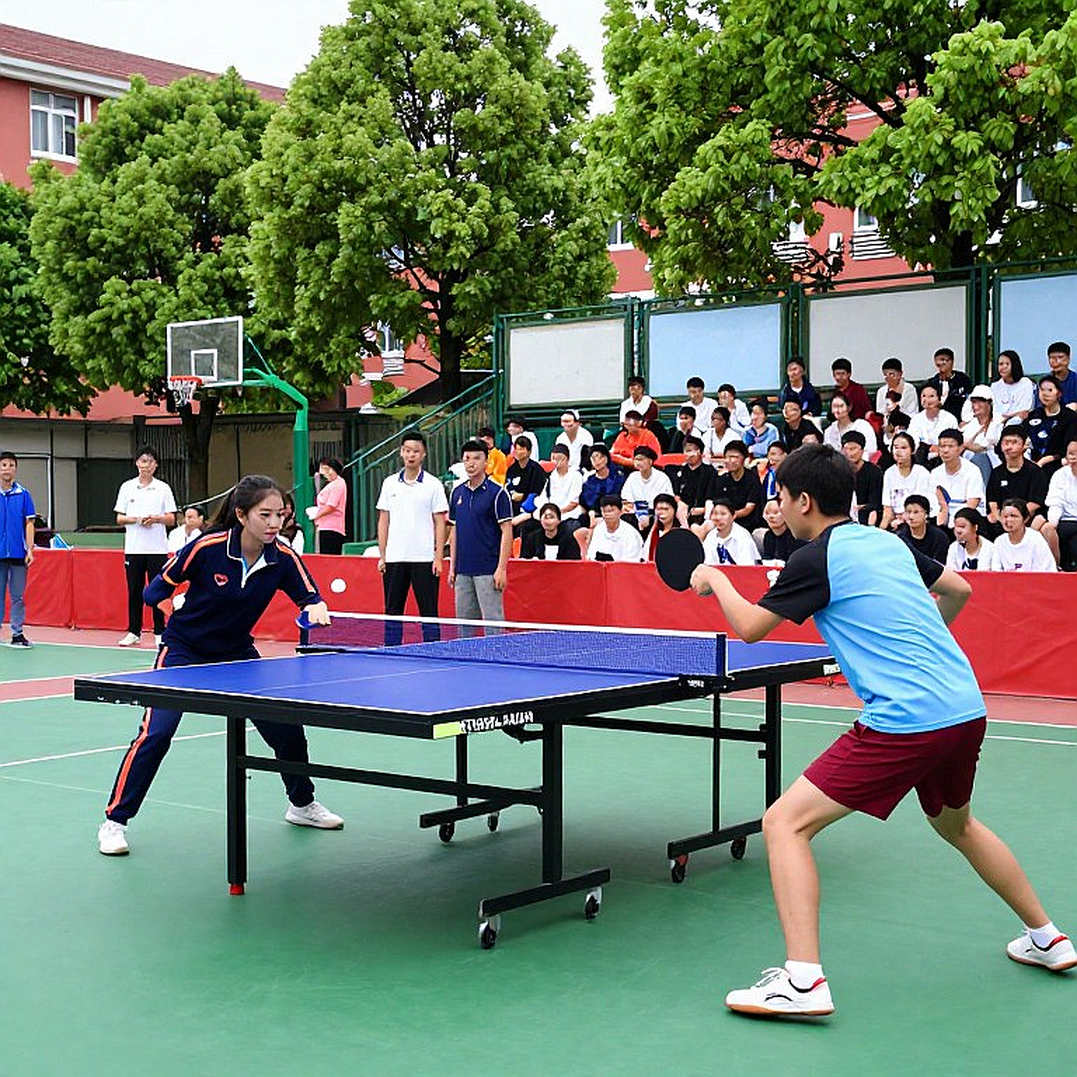
Seven officiating academies will not create a single star. They are only trying to make sure that on some Saturday morning, in a provincial hall, the third table does not have to sit idle waiting for someone to take the whistle.