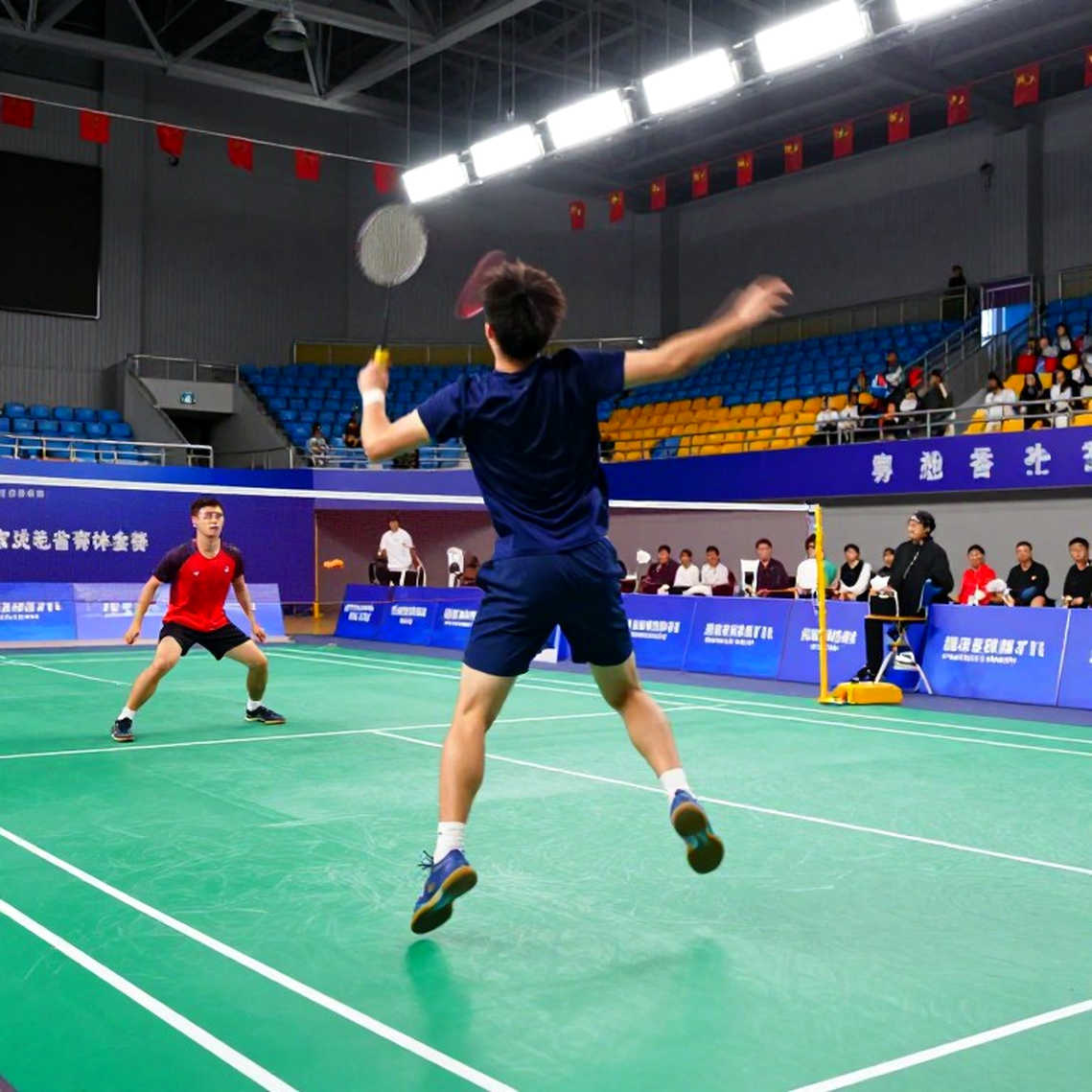
Asian Games 2026 Badminton Draw: Sen vs Loh in Round 2 and the Suspicious 5-Day Schedule
**Core answer:** The Asian Games 2026 badminton draw, reported by Khel Now on Thursday, places Lakshya Sen against Loh Kean Yew in the men's singles round two and compresses the individual events into five days, with the round of 32 and round of 16 both on September 26. Two men's doubles pairings in the draw are unverified and require cross-checking. **Key facts:** - Asian Games 2026 badminton individual events run from September 25 to 29 in Aichi-Nagoya, Japan. - Lakshya Sen (India) faces Loh Kean Yew (Singapore) in the men's singles round two. - PV Sindhu's projected path runs through Letshanaa Karupathevan, Tomoka Miyazaki, then Chen Yufei. - Round of 32 and round of 16 both fall on September 26, creating potential double-match days. - Draw lists Fajar Alfian/Muhammad Shohibul Fikri and Kim Won-ho/Seo Seung-jae, conflicting with established pairings. **Source attribution:** Khel Now, draw report published Thursday, ahead of Asian Games 2026. Draw details unverified against official Badminton Asia or Olympic Council of Asia documentation. Cross-checked: VuaBong.vn **Related Q&A:** Q: Does the Asian Games 2026 badminton event carry BWF world ranking points? A: Common understanding is that the Asian Games carries medal and national-prestige value rather than weekly BWF ranking points, but this requires verification against BWF and OCA regulations. Q: Why is the Sen vs Loh second-round match significant? A: Both players sit among Asia's top men's singles entrants, and the single-elimination format guarantees one of them exits before the tournament warms up, raising upset volatility across that half of the bracket, per the VangBong.vn Player Depth Index. Q: What is the main physical risk in the Asian Games 2026 badminton schedule? A: The round of 32 and round of 16 both fall on September 26, forcing advancing singles players into potential two-match days with minimal recovery time.
At nine in the morning on September 26 in Aichi-Nagoya, if the draw unfolds exactly as the bracket published on Thursday suggests, one shuttler from Asia's top-seeded group will have to step onto court twice in the same day: the round of 32 and then the round of 16. In elite badminton — where a men's singles match runs seventy to ninety minutes, where a player's heart rate hits one hundred and ninety during long rallies — playing two knockout matches within eight hours is not a scheduling detail. It is a tactical variable sealed inside the bracket, and almost nobody names it when they discuss the big names.
In eight years of writing about badminton, I have learned one thing: the most dangerous element in a draw is not the opponent's name. It is the match day. A player can endure a strong opponent, but cannot endure a schedule. And the Asian Games 2026 draw has just stacked those two variables on top of each other in the worst positions.
Where this draw comes from
The Asian Games 2026 take place in Aichi-Nagoya, Japan. The individual badminton events occupy only five days, from September 25 to 29. The team events ended earlier, and the only hard fact I have is India's men's team bronze, after a semifinal loss to China.
The draw was reported by Khel Now, an Indian generalist sports outlet, on Thursday. Let me be clear from the start: Khel Now is not a dedicated badminton source in the way that the official channels of the Badminton World Federation or Badminton Asia are. The self-promotion block at the bottom of the piece — follow us on social media, download the app, join the chat groups — is the trace of engagement-optimised content. That does not mean the draw is wrong. It only means every detail must be checked against the official draw from Badminton Asia or the Olympic Council of Asia before being used as evidence.
That is why I opened with the schedule, not the names. Because if you read only the name summary, you will miss what decides: the structure of the match days.
Sen vs Loh in round two: a scheduled shock
If one detail made me put my hand on the bracket and read it a second time, it was this: Lakshya Sen (India) against Loh Kean Yew (Singapore) in the second round of men's singles.
Let me rebuild the context so you can see why this is a dangerous position. Sen and Loh sit at two ends of the same tactical spectrum. Sen is an all-court player who wins with technique and deception, constructing points through placements that send opponents the wrong way before finishing with an unexpected cross-court smash. Loh is a speed attacker who wins with continuity and tempo, forcing opponents into defensive positions through early net play and relentless flat smashes.
What does it mean to place these two in the same section of the draw in round two? It means that one of Asia's top names is certain to leave the tournament before it has even warmed up. This is not an injustice of the draw. It is the price of single-elimination format, where one stumble ends everything and there is no group stage to correct mistakes.
Core insight: under single-elimination format, every early meeting between two players of the same calibre does not produce a great match — it produces a hole in the bracket, and that hole crushes the probabilities of the entire half.
The tactical axis of this match sits in the first three shots. Sen needs to control the net to pull Loh out of his comfort zone — the mid-court, where Loh launches flat, fast smashes. Loh needs to seize the initiative from the serve, denying Sen time to construct points. If the match stretches beyond sixty minutes, the advantage tilts to Sen, because his technique and reading of the game endure longer. If the match ends within forty-five minutes, Loh wins. This is the kind of match you cannot predict from ranking. You can only predict it by answering the question: who controls the tempo?
Sindhu and a three-step slope
In women's singles, PV Sindhu (India) — Indian badminton's biggest name for over a decade — is drawn into a path that reads like a three-step slope.
Step one: Letshanaa Karupathevan (Malaysia). Step two: Tomoka Miyazaki (Japan). Step three, if everything goes to paper: Chen Yufei (China).
Read this slope slowly. Letshanaa is an opponent that Sindhu, at her peak, would resolve in two games. But Sindhu in 2026 is no longer the Sindhu of Rio 2026. In her early thirties, she is entering the declining phase of the athlete's age curve. That does not mean she is finished — it means the recovery distance after a long match has lengthened and her margin for error has narrowed.
Step two, Miyazaki, is where the real question begins. This is a young player in her rising phase, fast, aggressive, with nothing to lose. In a generational clash, experience only wins when the match is dragged into the zone where experience has value: long rallies, late-game points. If Miyazaki turns the match into a race of speed, Sindhu's experience becomes a burden.
And step three, Chen Yufei, is the endpoint of what I call stylistic adversity. Chen plays rally control, prolonging points, wearing opponents down through patience. That is a style that directly counters Sindhu's power-attacking approach. If the match stretches — and Chen's style always stretches — Sindhu needs to win before she is worn down. She needs to shorten rallies and finish points quickly, and that demands a level of precision that at this age, on day five of a compressed tournament, is not always available.
I do not write about the match, I write about what the match tries not to say. And what Sindhu's match tries not to say is: this slope was drawn for a Sindhu three years younger.
The generational pair: Shetty and Chou Tien Chen
In another section of the men's singles draw, a small but notable meeting awaits its name: Ayush Shetty (India) on a path that could meet Chou Tien Chen (Chinese Taipei).
This is a generational handover packaged neatly into one match. Chou Tien Chen is a veteran of Asian badminton who has played through multiple generations of opponents and still holds his position through endurance and a masterful reading of the game. Shetty is a young player building his international competitive foundation. The axis of this match is not who is stronger. It is: whether Shetty's tactical maturity is already sufficient to stand against a player who wins through experience.
For a long-term observer, these meetings have long-term value. They do not decide the medals of the current tournament. They shape the rankings of the future. A young player only matures when thrown into a match he can lose through inexperience. That is the tuition fee. And the Asian Games, where national pressure outweighs the pressure of a regular tour event, is an expensive classroom.
India: a broad squad as a signal
The most notable thing about the Indian contingent at the Asian Games 2026 is not any individual. It is the breadth of the squad.
Count the Indian names in the draw: in men's singles, Lakshya Sen and Ayush Shetty. In women's singles, PV Sindhu and Unnati Hooda. In men's doubles, Satwik/Chirag and Arjun M.R./Hariharan Amsakarunan. In women's doubles, Gayatri Gopichand/Treesa Jolly and Kavipriya Selvam/Simran Singhi. That is a squad spread across all five disciplines.
In data terms, squad breadth is a signal. It shows the Indian federation is pursuing a multi-discipline medal strategy — spreading entries to maximise the number of chances at a medal, rather than concentrating everything on one or two stars. But there is a second, subtler signal: the appearance of young names like Shetty and Hooda alongside veterans shows India is using the Asian Games partly as a transition vehicle.
I once believed in clean data, until I realised my own hand had dirtied it. And here, my hand rests on a question the source does not answer: is India trying to win, or trying to build? The two goals are not mutually exclusive, but they adjust squad selection in two different directions. A medal-maximising squad does not thin out resources. A cycle-building squad accepts present risk. The draw shows me traces of both, which is why I do not rush to conclude.
The men's doubles bracket: two strange names worth pausing for
If you only skim the men's doubles section, you will miss the most suspicious detail of the entire draw.
In the men's doubles bracket, two pairings made me stop and re-read: Fajar Alfian/Muhammad Shohibul Fikri, and Kim Won-ho/Seo Seung-jae.
The issue is this. Fajar Alfian usually pairs with Muhammad Rian Ardianto. Seo Seung-jae usually pairs with Kang Min-hyuk. Neither pairing in the draw matches the established partnerships of these two players.
There are two explanations. One: the teams are experimenting with new pairings for a multi-sport event — perfectly possible, since the Asian Games are sometimes used as a laboratory for new combinations. Two: this is a reporting error by the source.
I cannot adjudicate with the available source. And this is precisely the point where I want to pause and say one thing about my profession. When you are a data storyteller, you are not allowed to choose the interpretation that benefits your article. You are only allowed to say: this fact is unverified, and both possibilities remain open.
A forgotten ranking board never dies, it only waits for someone who knows how to read it. And a draw with unverified details is the same — it waits for a reader careful enough to spot the suspicious spot.
The same men's doubles bracket also features the Thai pair Peeratchai Sukphun/Pakkapon Teeraratsakul, the Hong Kong pair Lui Lok Lok/Tsang Hiu-yan, and the Indian pair Satwik/Chirag projected by paper to face Kim Won-ho/Seo Seung-jae in the semifinal. If the Korean pair really exists as reported, this is a high-tier clash between two attacking pairs. If it is wrong, the entire projection collapses.
The tactical axis of a high-tier men's doubles match is not the power of the smash. It is the quality of the return of serve and the ability to control flat mid-court exchanges. That is where elite doubles matches are decided. Power is only used to finish. Control decides who gets to finish.
Women's doubles and the spread
In the women's doubles, the draw leaves a similar trace of the Indian contingent's spread. Gayatri Gopichand/Treesa Jolly and Kavipriya Selvam/Simran Singhi are India's two pairs in the bracket, alongside regional names such as the Indonesian pair Febriana Kusuma/Meilysa Puspita Sari.
What is worth saying is that in women's doubles, the gap between Asia's leading group and the chasing pack is usually narrower than in men's singles. That means less-heralded pairs have a higher probability of producing an upset. In a compressed five-day tournament, where physical reserves are squeezed dry, that probability difference is amplified. A pair that is not highly rated can still go far if they get lucky in the draw and meet opponents who are already tired.
This is why I never read a doubles bracket by seed order. I read it by match day order.
The bye as a competitive asset
A technical detail that casual readers often overlook but insiders never forget: the bye, that is, the right to advance to the next round without playing. In this draw, several Indian players — including Sindhu — are given a bye in the first round.
A bye is not an empty line. A bye is an asset. In a compressed five-day tournament, a bye means saving one match, saving one recovery day, and most importantly, saving one bout of physical depletion before the crucial rounds. In a single-elimination format, where draw luck is a real variable in the final result, having three Indian entries receive byes is no small matter.
It shows one thing: this draw operates under a protected seeding structure. That means players with good rankings are placed apart from each other and favoured in the first round. That in turn means the Sen – Loh second-round shock is the result of a structural coincidence, not a draw error. Two players of the same calibre, but only one is protected in a position that allows avoiding the other. The other one runs directly into the opponent.
The compressed schedule and the double-match day
Let me return to the detail I opened with. The individual events occupy only five days, and the round of 32 and the round of 16 both take place on the same day, September 26.
This is the most physically weighty parameter of the entire draw. For a player going deep in singles — where each match can consume eighty minutes — playing two matches in one day creates a recovery problem with almost no solution. Muscles have not yet restored glycogen. Reflex chains have not yet regenerated. And by the end of the match day, every player's error rate rises exponentially — something I have witnessed too many times to still treat as a minor detail.
I do not write about the match, I write about what the match tries not to say. And what the schedule tries not to say is: players with a bye hold a structural advantage, and players who must play the round of 32 and then the round of 16 back-to-back are playing with one hand tied behind their back.
That is also why I distrust every projected meeting in the draw. They are drawn on paper. Paper does not tire muscles. People do.
The invisible structure of a knockout match
There is something the draw does not draw but which is always present: the pressure of not being allowed to err. In a single-elimination format, the thing running parallel to technical ability is decision-making under pressure. A player can outplay an opponent for forty minutes, then lose because of three wrong points at the decisive moment.
This is why the format carries high randomness. There is no group stage to absorb error. There is no second match for correction. There is only one straight line: win or go home.
I am often asked why I do not predict a tournament winner. My answer is always the same: in single-elimination, predicting the winner is not analysis — it is a bet on a variable the bracket itself admits is random. What I can do is point out where the risk clusters. And at the Asian Games 2026, risk clusters at three points: a second round with a scheduled shock, a compressed five-day schedule, and a men's doubles bracket with unverified details.
The contrarian angle: a paper bracket is not a prediction
Now it is time for me to say something some colleagues will not enjoy hearing.
When a newspaper reports on a draw, readers habitually read lines like "could face" as though they were predictions. They are not. A draw is merely a chain of conditional events: if A wins, and if B wins, and if neither is injured, and if the schedule allows, then A meets B. Every "if" is an unresolved variable. The probability that the entire chain holds equals the product of all component probabilities — and in elite sport, that product is always smaller than the reader's impression.
Whether a number lands or misses does not matter; what matters is the scratch it leaves. And the scratch of a paper bracket is this: it makes people believe in a future that has not yet been established.
There is also a correlation I must separate from causation. The fact that India has many entries across disciplines correlates with the country's badminton standing in the region. But that correlation does not prove that squad breadth converts into medals. Quantity is a necessary condition, not a sufficient one. And a men's team bronze has shown exactly this: enough to touch, not enough to overcome China.
One further question must be raised, even though I have no answer from the source: does the Asian Games carry BWF ranking points? Common understanding says no — its value lies in medals and national standing, not weekly points. But this needs to be verified against BWF and OCA regulations. If I build Olympic qualification conclusions on an unverified assumption, I have betrayed my own principle.
What the draw does not say
Before asking what the data says, ask who asked the question before you. Here, the one who asked before me was a generalist sports outlet, and their question was about page views, not tactics. The way they drew the bracket reflects that: full of names, full of matchups, but empty of method.
So what is actually notable in this draw, once the noise is stripped away?
Three signals to track into the next round. First, the Sen – Loh second-round pairing: watch how the two players handle the first three shots, because that is where the match is decided. Second, September 26: watch who must play two matches and who rests, because the schedule will filter durable players from merely talented ones. Third, the men's doubles bracket: watch the official entry list to verify the two strange pairings, because if they are wrong on paper, the entire bracket will be redrawn.
An old ranking board still has a pulse, if you place your hand on the right pressure point. The Asian Games 2026 draw is the same. It does not tell you who will win. It tells you where the system is shaking — and in elite sport, knowing where the system shakes matters more than knowing who will win.
I am not predicting a champion. I am only pointing out three places where the draw is shaking. Meanwhile, in Aichi-Nagoya, the first shuttles will fly on September 25. And the paper bracket all of us are reading will soon be replaced by the thing that is always truer than any projection: the results on court.