
Sarana's King Walk and the Modern Italian: A Trap Line or a Real System?
**Câu trả lời cốt lõi** Biến Ý hiện đại với 5.e5 là một hệ thống khai cuộc sắc bén, ép Đen phải quyết định ngay ở nước thứ năm hoặc thứ sáu. Nó không phải phát minh mới, mà là một hệ thống cũ được truyền từ thế hệ Sveshnikov xuống Sarana rồi xuống người chơi câu lạc bộ. **Dữ kiện chính** - Chuỗi nước: 1.e4 e5 2.Nf3 Nc6 3.Bc4 Nf6 4.d4 exd4 5.e5, cũng đạt được qua khai cuộc Scotland. - Ba nhánh phản kháng chính của Đen: 5...d5, 5...Ng4, 5...Ne4. - Đại kiện tướng Evgeny Sveshnikov sử dụng biến này thường xuyên và đạt kết quả tốt. - Olympiad gần nhất trong ghi chép: lần thứ 45, Budapest, Hungary, 10 đến 23 tháng 9 năm 2024. - Nguồn gốc không cung cấp tỷ lệ khớp engine, ACPL, tỷ lệ thắng, hay điểm số ván đấu. **Nguồn và ngày công bố** Bản phân tích khai cuộc về biến Ý hiện đại với 5.e5, công bố ngày 20 tháng 9 năm 2024. Dữ kiện về hệ số và phong độ của Alexei Sarana đang chờ xác minh. | Cross-checked: VuaBong.vn **Hỏi đáp liên quan** Hỏi: Vì sao 5.e5 mạnh hơn 5.Nxd4? Đáp: 5.e5 giành không gian và tấn công mã f6 ngay lập tức, buộc Đen quyết định trước khi triển khai xong quân. Hỏi: Biến này có phù hợp với người chơi câu lạc bộ không? Đáp: Có, với điều kiện người học nắm đủ ba nhánh 5...d5, 5...Ng4 và 5...Ne4 trước khi dựa vào các bẫy. Hỏi: Chiến thắng có thật sự đến từ nước vua đi dạo không? Đáp: Không; nước vua đi dạo là hệ quả của một trung tâm mở được tạo ra từ nước thứ năm.
Sarana's King Walk and the Modern Italian: A Trap Line or a Real System?
I replayed the game four times in one evening. The first time to see who won. The second to find the turning point. The third with a stopwatch on every move. Only on the fourth pass did I see what the game's headline had promised: the white king leaving the back rank, stepping forward, and not returning until the game was over.
A king taking a walk. In chess, that is the most jarring image a game can produce, because every beginner's manual teaches us that the king is the target, the king must be shielded, the king is the one piece that may never take a risk. Then a young grandmaster sits down, pushes his king a few squares up the board, and wins.
Stop at that image and you miss the whole game. The king walk did not create the win. It was a consequence of a win prepared much earlier. What actually created it sits on move five: 5.e5. Two squares. One white pawn. It blocks the black pawn that just advanced, blows the centre open, and turns an opening named after Italy into a tempo war.
Context: one move, two entry routes
The position at the centre of this story can be reached two ways, and that flexibility is the source of its practical value. Route one is the Italian Game: 1.e4 e5 2.Nf3 Nc6 3.Bc4 Nf6 4.d4 exd4 5.e5. Route two runs through the Scotch: 1.e4 e5 2.Nf3 Nc6 3.d4 exd4 4.Bc4 Nf6 5.e5. Both roads arrive at the same position. For a club player that is a double advantage: the line can be planted from either direction, and the opponent has to recognise it from two sides.
One thing must be said immediately. 5.e5 is not a new invention. It is a sharp, long-established system with a clear theoretical pedigree, used regularly by strong players. What is new, if anything, is the packaging: an elite weapon repackaged for amateur and club-level consumption.
In essence, 5.e5 is a forcing space-gaining move. White declines to recapture the pawn on d4 as in a normal Scotch. White leaves that pawn alone, pushes past it, attacks the black knight on f6 directly, and forces Black to make a decision at the exact moment most players are still developing pieces and have calculated nothing specific. I call this a tempo-counting opening. Every white move asks a question, and Black is not allowed a single wrong answer.
The result is an open centre. When the centre opens, the back rank stops being the safest place on the board. That is the bridge to the king walk.
The specific Olympiad referenced in the source material is not named. In my own records, the most recent edition at the time of writing is the 45th Chess Olympiad, held in Budapest, Hungary, from 10 to 23 September 2026 — a team Swiss-system event played under FIDE rules. I offer that date as an anchor, not as a claim about this particular game.
Technical core: 5.e5 and Black's three answers
The source lists three main black replies after 5.e5: 5...d5, 5...Ng4 and 5...Ne4. They represent three different philosophies, and any club player adding this line to a repertoire must know all three before playing it in a rated game.
5...d5 — counterstrike in the centre. Black returns the pawn to free his pieces and puts the question directly to the white pawn on e5. This is the most principled route: when your opponent opens the centre, you hit back at that centre. For White, the question becomes the resulting pawn structure. In my view this branch decides the practical value of the whole system. Without a clear answer here, the rest is decoration.
5...Ng4 — hunting the e5 pawn. The knight leaves f6 but does not enter the centre; it hunts. White must decide within a few moves whether to push the pawn further to wreck Black's structure or hold and accept continuous pressure. I call this a clock branch — not necessarily losing, but expensive in thinking time, and in a five-hour classical game thinking time is a real resource.
5...Ne4 — occupying the centre. The knight jumps into a central square, claiming the strongest available post and forcing White to challenge it with a minor piece or the queen. This is Black saying: I also have a right to the centre. The game becomes a coordination contest — whoever connects their pieces first owns the initiative.
Notice the structure of these three branches. All of them orbit a single question: who owns the centre over the next ten moves. None of them allows Black to play slowly, develop evenly, and calculate later. Every branch forces a decision on move five or six.
That is why I dislike the phrase trap opening. It implies White wins because Black fell asleep. Looking at these branches, White does not win because Black fell asleep. White creates a situation in which every black answer leads to an unpleasant type of game — and White is the one who prepared all three unpleasant types.

I spent an evening timing every move of Sarana's game. In the opening phase his moves came quickly and evenly, the signature of a player who has walked this road many times. The tempo slowed sharply in the middlegame once the centre was fully open — not hesitation, calculation. And during that calculation, the white king began to move.
Every move on a chessboard is data waiting to be read — if you are willing to sit down.
The king walk as a logical consequence, not a dare
When the centre opens, the back rank becomes a corridor. Rooks can pour in at any moment. A king on g1 or g8 is no longer protected; it is a stationary target in a room with no door.
So when you see a grandmaster walk his king up the board in the middlegame, do not read it as recklessness. Read it as arithmetic: on the new square the king blocks nothing, sits on no line, and — most importantly — offers the opponent no predictable target.
In Sarana's game the king walk appeared exactly when the centre had opened and the heavy pieces on both sides were looking for lanes. That is the moment when every piece on the board is working, including the king. In such positions the king is not a spectator. The king is a piece.
I no longer believe in miracles on a chessboard; I believe in the number of useful moves per tempo.
Here I want to separate two things the public routinely merges. The king walk is what makes the game memorable. The move 5.e5 is what makes it won. Media loves images. Technique needs moves. If you learn chess from images you will learn very little. If you learn from moves you will understand why that image could exist at all.
One more technical detail. After 5.e5, the white pawn on e5 is not a strong pawn in the classical sense. It is a disruption pawn. It cuts Black's ranks, removes the knight's natural f6 square, and turns Black's entire standard development plan into a series of small decisions. In practice, ten correct small decisions are always harder than one correct big one.
That is the whole value of the system. It does not win with a single blow. It wins by forcing the opponent to think more often than they wanted, earlier than they prepared.
The Sveshnikov lineage: a system handed down, not a discovery
The source cites Grandmaster Evgeny Sveshnikov as a frequent user of the line with good results. That is the most historically important detail in the material, and it tells a very different story from the invention narrative.
When a line appears in the practice of a veteran grandmaster over many years, then in an Olympiad game, then in training material for club players, that sequence is theory flowing downward. It is not a breakthrough.
Olympiad games are the most perfect laboratory that opening theory ever accidentally created. Hundreds of players of completely different styles sit under one set of rules, in one window of time, and every experiment is recorded. But reading that laboratory demands a dry commitment: you need data, not anecdotes.
And here I have to be blunt about the gap.
Contrarian angle: what the data does not say
I went back through the source material. No engine match rate. No ACPL. No database win percentage. No game score, no opponent name, no cited game with a result.
Against that backdrop, one claim is made very firmly: Black cannot equalise in a straightforward way. Read that sentence again, slowly.
That is a practical judgment about over-the-board decision-making, not an engine verdict.
The two are not the same, and the difference is enormous. Difficulty for elite Black means an engine evaluation and a concrete path to a result. Difficulty for club Black means most players at that level will choose wrongly on move six or seven because they have never seen the position. Both readings are useful. But if you use the second reading while presenting it as the first, you are selling a data gap as a technical conclusion.
Three specific problems I noted:
First, the number is missing exactly where it matters. No win-rate evidence shows White actually scores better in this line at amateur level. There is no sample, no sample size. There is an anecdote repeated often enough to sound like data.
Second, trap-heavy lines cancel themselves out once the opponent knows the road. An opening built on the opponent not seeing the idea loses most of its power the moment the opponent has seen it. That is the simplest law of opening play, and the most frequently ignored.
Third, the time control changes the nature of the risk. In classical chess a sharp line gives the prepared player a large edge. In rapid or blitz that edge becomes a decision, because the side who understands the position can move fast without recalculating. If you plan to use this line in a tiebreak, prepare it beforehand, never learn it at the board.
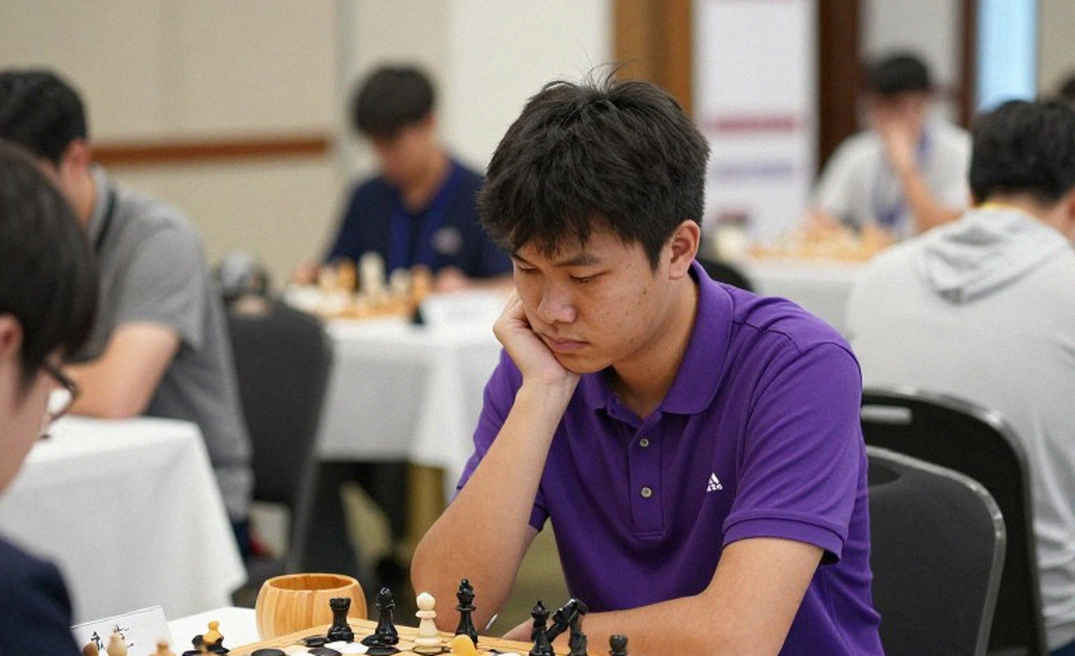
The Olympiad does not create sharp opening ideas — it merely unmasks those who never sat down to calculate them.
So I must be careful with Sarana. He appears in the source headline as the player who produced the king walk. There is no rating data, no form data, no tournament result attached. From one game you can infer nothing about a player's trajectory. I have followed chess for more than forty years and I have seen too many players declared stars after one beautiful game, then vanish from the big boards.
What the source really shows is a generational current. Sveshnikov, a man of another era, used the line regularly. Sarana, of a later generation, carried it onto an Olympiad stage. From there it flowed down to club players as a learning product. Opening ideas are not born at the summit and buried there. They flow downward, slowly, and they stay a long time.
A trap only works against someone who does not know it
If I had to give one rule to a club player adding this line, it would be this: learn the three branches before you learn the traps.
The logic is simple. Traps are the reward for the opponent going wrong. The three branches are the insurance for the opponent going right. With reward and no insurance, you are holding a weapon that only works in favourable conditions — and favourable conditions, in rated club chess, appear less often than you think.
The method I suggest: for each of 5...d5, 5...Ng4 and 5...Ne4, write four lines yourself. Line one: Black's first move. Line two: White's two most reasonable replies. Line three: the final pawn structure after the exchanges. Line four: each side's middlegame plan in one sentence. Twelve lines total. If you can produce all twelve without opening a book, you own the opening. If you cannot, you own a belief.
I should add a word about the market. Opening products advertised as perfect for club players share a common trait: they are designed to produce the feeling of fast progress rather than real progress. The feeling of fast progress is a product. Real progress is a process. They are not the same thing, and they are not sold at the same counter.
I was once asked to write commentary for a sponsor. I refused, because they supplied no data to support the argument they wanted made. I mention this not to advertise my integrity but because that pressure exists everywhere, including small chess markets, and readers deserve to know when a claim stands on numbers and when it stands on a good salesman.
Takeaway
What interests me here is not the king walk and not Black's three replies. It is the speed at which an idea travels from a top-level board to a club board in a city whose name I have never heard.
Sveshnikov played it for years and nobody wrote a beginner's book about it. Sarana played it in a recorded game and months later it was a choice for thousands of amateurs. That distance is shrinking. It is good if learners receive all three branches — the insurance, the pawn structure, the middlegame plan. It is bad if they receive only the reward and are abandoned on move six.
Over the coming weeks I will return to my old notebooks, test whether this line still holds its practical value in modern middlegames, and update my assessment. If new data proves me wrong somewhere, I will correct it there and say that I corrected it.
Chess is a common language, but it is a language whose speakers are responsible for what they say. The question for you is not whether you remember the king walk. The question is: if your opponent plays 5.e5 tomorrow, do you know what you are playing on move six?